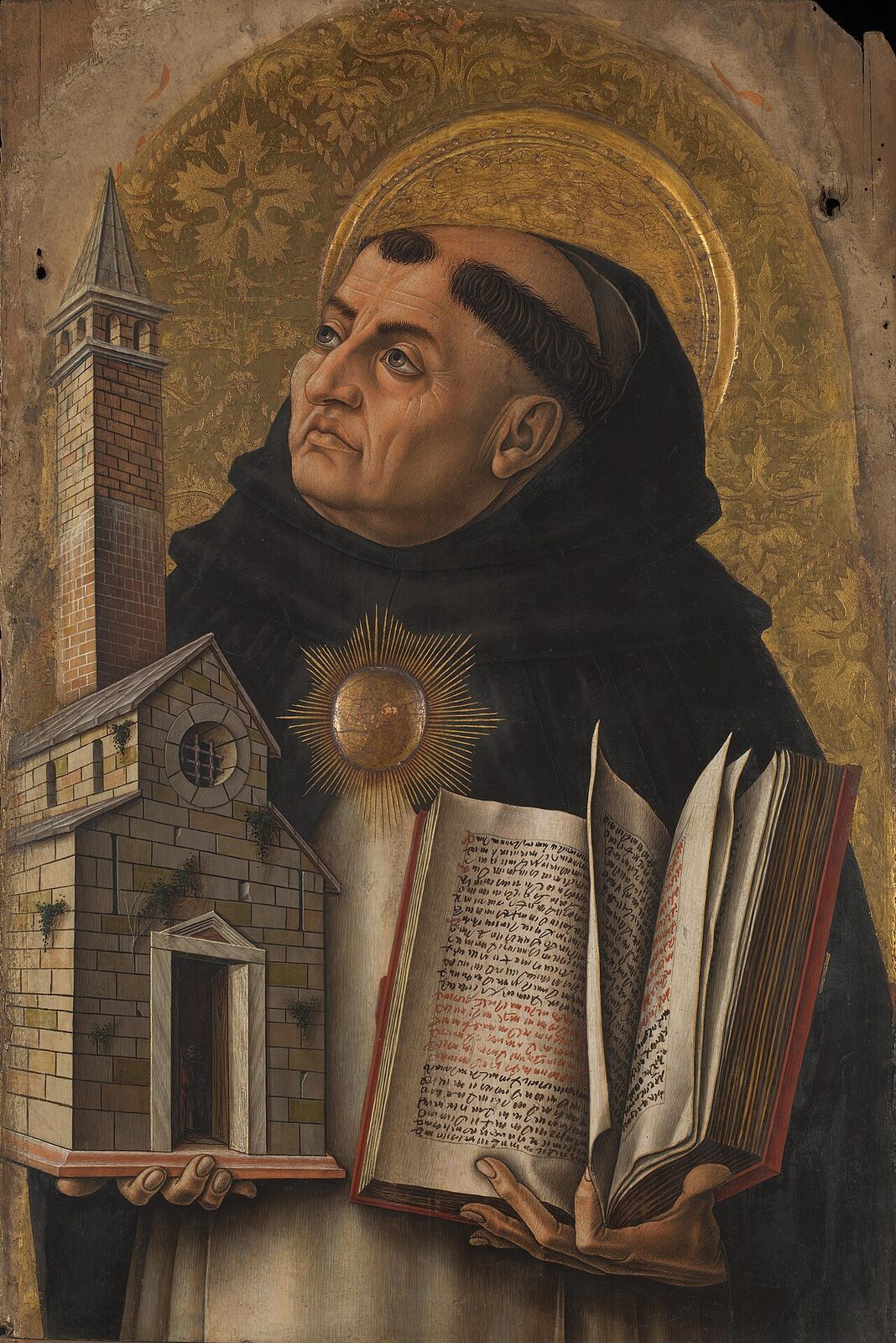
Life
Thomas Aquinas in their own century
Born to a noble family near Aquino, Aquinas joined the Dominicans against his family’s wishes, studied under Albert the Great, and taught at Paris and Naples. He stopped writing in 1273 and died the following year on the way to the Council of Lyon.
Newly available Arabic and Greek Aristotle had been condemned in Paris; his career is a sustained argument that this pagan philosophy could be used rather than banned.
Central ideas
Natural law
Moral obligation is legible in human nature and accessible to reason, so ethics is not reducible to revealed command.
Faith and reason
Reason and faith have distinct scopes but cannot contradict, since both are directed at the same reality — a claim that licensed scientific inquiry within theology.
Being
He distinguishes essence from existence, treating the act of being as what any finite thing receives rather than possesses in itself.
Criticism & debate
Critics dispute whether natural law can deliver determinate answers without smuggling in theology; his cosmological arguments were pressed hard by Hume and Kant, and Reformers rejected the whole Aristotelian apparatus.
Influence
Thomism became the reference framework of Catholic philosophy and remains central to natural-law ethics, human-rights argument and contemporary virtue theory.
How to read them
Begin Thomas Aquinas with the tension between natural law and faith and reason. Read the major works slowly enough to notice how biography, public crisis and method shape the argument rather than treating the thinker as a list of doctrines.
If Thomas Aquinas is right about natural law, what habit of judgement would have to change first?
In their words
“Grace does not destroy nature but perfects it.”