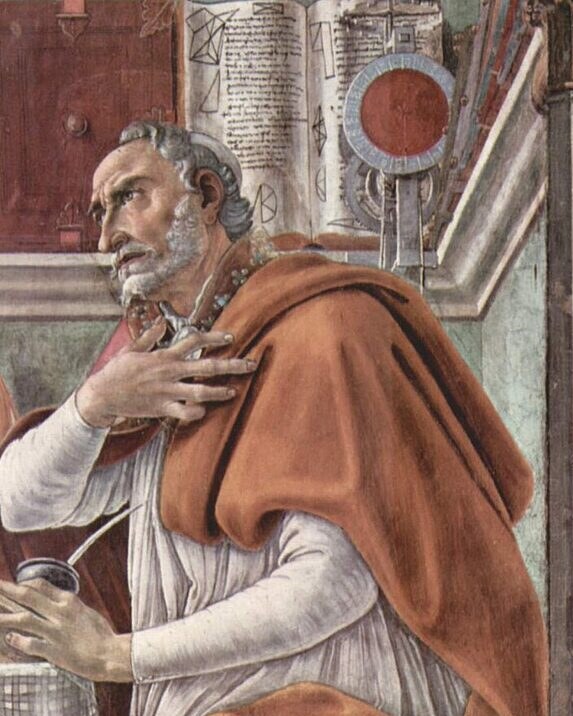
Life
Augustine in their own century
Born at Thagaste in Roman North Africa, Augustine taught rhetoric in Carthage, Rome and Milan, passed through Manichaeism and Neoplatonism before his conversion in 386, and served as bishop of Hippo from 395 until his death as Vandal armies advanced.
He wrote as the western empire came apart; the City of God answers pagan Romans who blamed Christianity for the sack of Rome in 410.
Central ideas
Interior self
The Confessions turn philosophical attention inward, treating memory, habit and divided will as the terrain where a life is decided.
Time
He argues that past and future exist only as present memory and expectation, making time a feature of the soul’s attention rather than a measurable thing.
Grace
Against Pelagius he holds that the will is bound by habit and cannot free itself, so genuine change depends on grace — a position that shaped centuries of debate on freedom.
Criticism & debate
His doctrines of original sin and predestination have been attacked as fatalistic and psychologically harmful, and his late endorsement of coercing schismatics is a standing objection to his political theology.
Influence
He is the decisive bridge from ancient philosophy to medieval Christian thought, and his interiority echoes in Descartes, Pascal, Kierkegaard and Heidegger’s early lectures.
How to read them
Begin Augustine with the tension between interior self and time. Read the major works slowly enough to notice how biography, public crisis and method shape the argument rather than treating the thinker as a list of doctrines.
If Augustine is right about interior self, what habit of judgement would have to change first?
In their words
“Our heart is restless until it rests in you.”
“What then is time? If no one asks me, I know; if I wish to explain it to one who asks, I know not.”
“Late have I loved you, beauty so old and so new.”