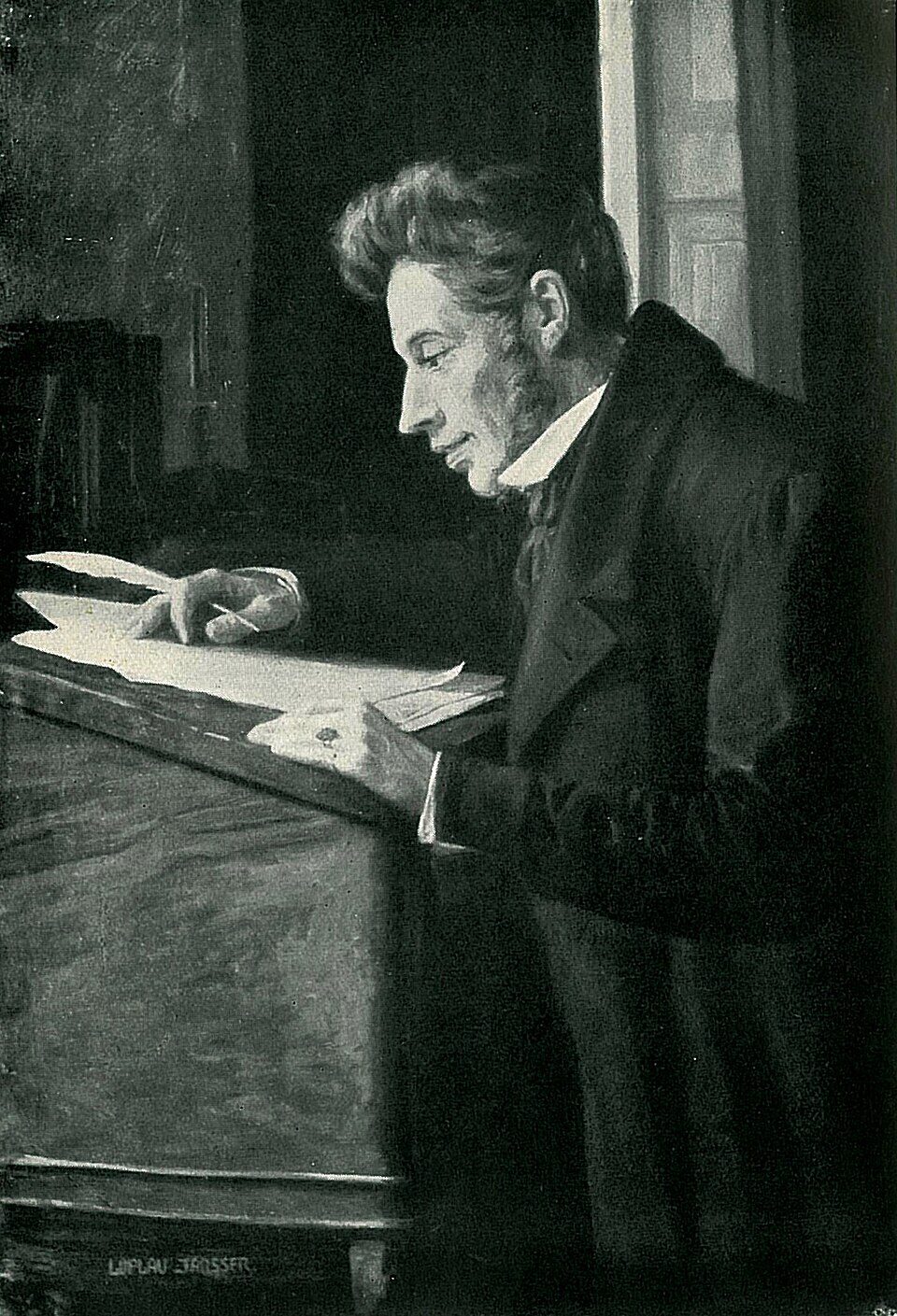
Life
Søren Kierkegaard in their own century
Kierkegaard lived on his father’s fortune in Copenhagen, broke his engagement to Regine Olsen, published a stream of books under pseudonyms, and spent his last year attacking the Danish state church before collapsing in the street at forty-two.
His target was a Christendom in which everyone was nominally Christian by birth; he wrote to make faith difficult again for a comfortable bourgeois public.
Central ideas
Leap of faith
Faith is not a conclusion from evidence but a decision taken beyond what reason can secure, which is why Abraham cannot explain himself.
Anxiety
Anxiety is not fear of a thing but the dizziness that comes with possibility itself — the awareness that one could choose otherwise.
Subjectivity
Truth that matters for existence must be appropriated by a particular person; a system that leaves out the one who holds it has left out everything.
Criticism & debate
Critics argue that privileging inwardness makes faith arbitrary and immune to criticism, and that his ethics offers little guidance for shared political life.
Influence
Largely unread outside Denmark until the early twentieth century, he then became the acknowledged starting point for existentialism, for Barth’s theology and for Heidegger’s analysis of anxiety.
How to read them
Begin Søren Kierkegaard with the tension between leap of faith and anxiety. Read the major works slowly enough to notice how biography, public crisis and method shape the argument rather than treating the thinker as a list of doctrines.
If Søren Kierkegaard is right about leap of faith, what habit of judgement would have to change first?
In their words
“Anxiety is the dizziness of freedom.”
“Life must be understood backwards.”
“Subjectivity is truth.”