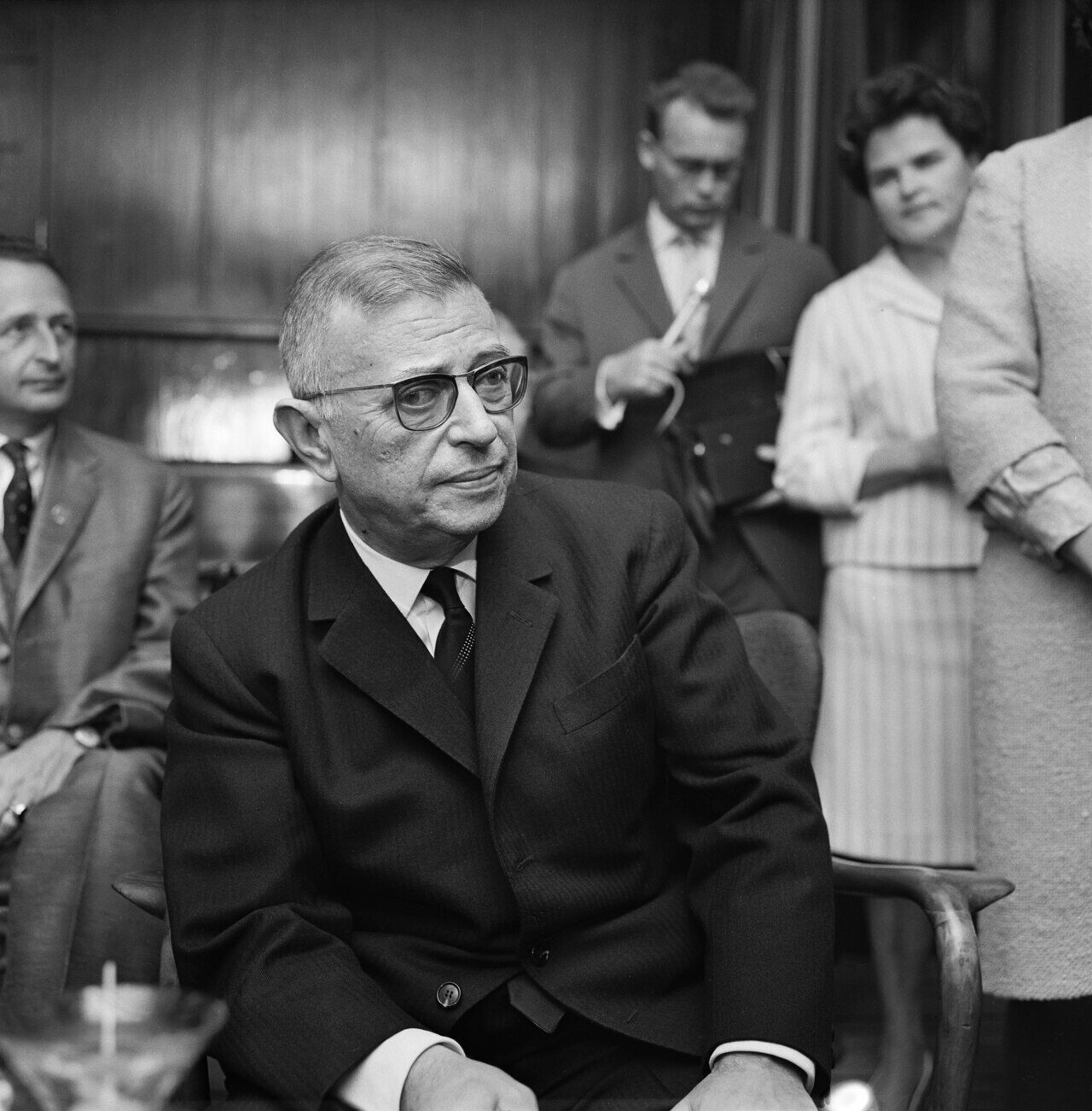
Life
Jean-Paul Sartre in their own century
Educated at the École Normale Supérieure, Sartre taught philosophy, was held as a prisoner of war in 1940, wrote Being and Nothingness under occupation, founded Les Temps modernes, and declined the Nobel Prize in Literature in 1964.
Occupation and resistance gave his account of choice under constraint its urgency, and the Cold War shaped his long, contested engagement with communism and with Algerian independence.
Central ideas
Existence precedes essence
There is no human nature given in advance; a person is the sum of what they make of their situation, and cannot appeal to type or instinct.
Bad faith
Bad faith is the self-deception of treating one’s own freedom as a fixed role — the waiter who is only a waiter, the coward who was born that way.
Freedom
Freedom is inescapable rather than pleasant: since even refusal is a choice, responsibility extends to the meaning we let our situation have.
Criticism & debate
Beauvoir and Merleau-Ponty argued that his early account underrates how body, gender and class situate freedom; his defence of Stalinist and later Maoist politics remains the sharpest charge against his judgement.
Influence
He made existentialism a public philosophy, shaped post-war French thought and anticolonial writing, and remains central to debates on freedom and responsibility.
How to read them
Begin Jean-Paul Sartre with the tension between existence precedes essence and bad faith. Read the major works slowly enough to notice how biography, public crisis and method shape the argument rather than treating the thinker as a list of doctrines.
If Jean-Paul Sartre is right about existence precedes essence, what habit of judgement would have to change first?
In their words
“Existence precedes essence.”
“Man is condemned to be free.”
“Man is nothing else but what he makes of himself.”