Life
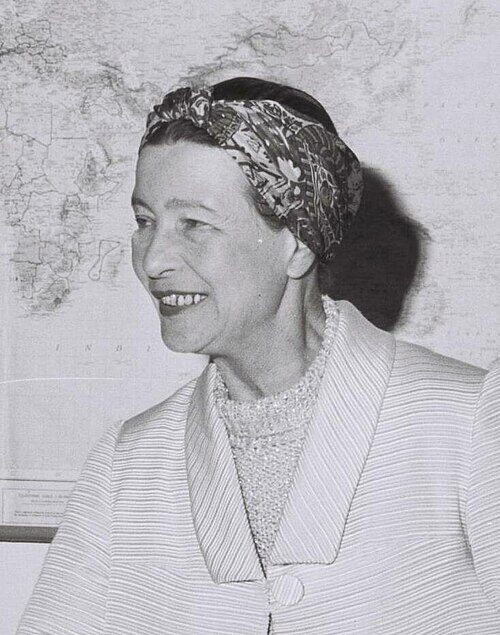
Simone de Beauvoir in their own century
The youngest person to pass the agrégation in philosophy in her year, Beauvoir taught, then wrote full time: novels, the Ethics of Ambiguity, The Second Sex in 1949, and a four-volume memoir. She campaigned for abortion rights in France into the 1970s.
She wrote The Second Sex in a country where women had voted only since 1944 and contraception was illegal; the Vatican placed the book on its index of prohibited works.
Central ideas
Ethics of ambiguity
Freedom has no guarantee outside itself, so ethics must be built without appeal to fixed values — and without pretending our choices are innocent.
Otherness
Woman has been constructed as the Other against which man is defined as the norm, a relation reproduced by upbringing, law and myth rather than by biology.
Situated freedom
Freedom is always situated: bodies, money, work and history set the terms within which a person can project a life, which is why liberation is political as well as personal.
Criticism & debate
Later feminists criticised her reliance on Sartrean categories, her account of motherhood and maternity, and the class and racial limits of her perspective; Parshley’s abridged 1953 translation distorted the argument for decades.
Influence
The Second Sex founded modern feminist philosophy and gave later theorists of gender their central distinction between the given and the constructed.
How to read them
Begin Simone de Beauvoir with the tension between ethics of ambiguity and otherness. Read the major works slowly enough to notice how biography, public crisis and method shape the argument rather than treating the thinker as a list of doctrines.
If Simone de Beauvoir is right about ethics of ambiguity, what habit of judgement would have to change first?
In their words
“One is not born, but rather becomes, a woman.”
“The body is not a thing, it is a situation.”