Stoicism
c. 170–180 CE · Beginner
Written for himself rather than for publication, it survives as the most personal document of Roman Stoic practice.
The Essential Shelf
A considered library for beginning, deepening, and testing a philosophical education.
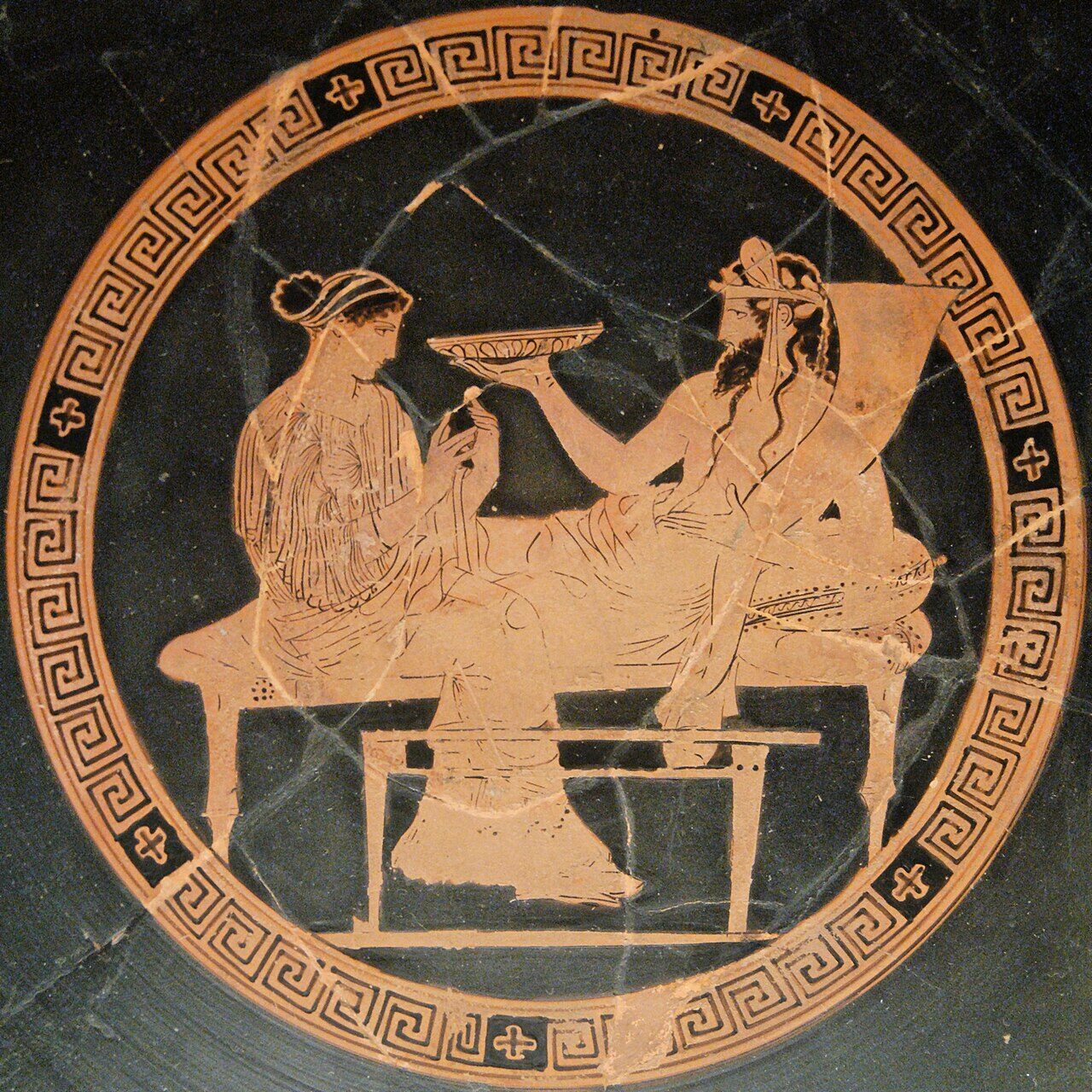
Object in Focus
Attic red-figure kylix depicting Persephone and Hades, attributed to the Codrus Painter, c. 440–430 BCE. British Museum.
Stoicism
c. 170–180 CE · Beginner
Written for himself rather than for publication, it survives as the most personal document of Roman Stoic practice.
Platonism
c. 375 BCE · Intermediate
The founding text of Western political philosophy, argued with and against for over two millennia.
Virtue ethics
4th century BCE · Intermediate
The origin of virtue ethics and still the standard reference point for character-based moral theory.
Stoicism
c. 62–65 CE · Beginner
The most readable entry point into Stoicism, blending moral argument with lived detail.
Genealogy
1886 · Advanced
A pivotal challenge to moral philosophy that shaped later existentialism, genealogy, and critical theory.
Value creation
1883–1885 · Advanced
Nietzsche’s most influential and most misread work, written as prophecy and parody at once.
Absurdism
1942 · Intermediate
Defined absurdism as a distinct response to the loss of inherited meaning.
Existentialism
1943 · Advanced
The systematic core of French existentialism and its phenomenological method.
Absurdism
1942 · Beginner
A novel that carried absurdist philosophy into world literature.
Existentialism
1949 · Advanced
A foundational work of feminist philosophy and of situated existential ethics.
Idealism
1781 / 1787 · Advanced
The dividing line of modern philosophy: nearly everything after responds to it.
Political philosophy
1651 · Intermediate
The first fully modern social-contract argument, still central to political theory.
Stoicism
c. 125 CE · Beginner
Copied and taught for centuries, including in Christian adaptations, it carried Stoic training into later Europe.
Christian Platonism
c. 397–400 CE · Intermediate
The first sustained Western autobiography and a bridge between ancient philosophy and medieval theology.
Scholasticism
1265–1274 · Advanced
The organising monument of scholastic thought and still the reference point for natural-law ethics.
Rationalism
1637 · Beginner
Written in French for a wide audience, it announced the modern turn toward the knowing subject.
Rationalism
1677 · Advanced
Written in geometrical order and published after his death, it became the great heterodox system of the age.
Empiricism
1689 · Advanced
The founding statement of British empiricism, decisive for Hume, Kant, and modern liberal thought.
Empiricism
1748 · Intermediate
Hume’s clearest work, and the provocation that Kant said woke him from dogmatic slumber.
Deontology
1785 · Intermediate
The short book behind most modern rights talk and the standard rival to utilitarian ethics.
Pessimism
1818 · Advanced
Brought Indian philosophy into European debate and shaped Nietzsche, Wagner, and Freud.
Existentialism
1843 · Intermediate
Published pseudonymously, it made Kierkegaard the starting point of existential thought.
Marxism
1848 · Beginner
A political pamphlet that became one of the most consequential texts of the modern era.
Liberalism
1859 · Beginner
The classic liberal argument for free expression and the limits of majority power.
Utilitarianism
1863 · Beginner
The most influential defence of consequentialist ethics, still the main rival to Kantian duty.
Absurdism
1951 · Advanced
The book that broke Camus’ friendship with Sartre and reframed post-war debates over political violence.
Political philosophy
1958 · Advanced
Arendt’s central work of political philosophy and a lasting defence of the public realm.
Classical Greek
c. 399–387 BCE · Beginner
The essential doorway into Socrates: short, dramatic, and still the clearest statement of philosophy as a risk taken in public.
Platonism
c. 385–370 BCE · Beginner
A literary masterpiece that lets readers see philosophical eros as both desire and education.
Political philosophy
4th century BCE · Intermediate
A foundational work for political science, valuable both for its analytic clarity and for the moral limits modern readers must confront.
Aristotelianism
4th century BCE · Advanced
Dense and difficult, it established the vocabulary by which medieval and later European philosophy asked what reality most fundamentally is.
Epicureanism
1st century BCE · Intermediate
The major surviving poetic vehicle of Epicurean physics, and a decisive text for Renaissance and early modern materialism.
Stoicism
c. 108 CE · Intermediate
The fuller companion to the Enchiridion, showing Stoic practice as a demanding pedagogy rather than a set of slogans.
Christian Platonism
413–426 CE · Advanced
A monumental late-antique response to political catastrophe and one of the founding works of Christian political thought.
Rationalism
1641 · Intermediate
The most concentrated statement of Cartesian metaphysics and epistemology, still unavoidable in philosophy of mind.
Liberalism
1689 · Intermediate
A central liberal text, powerful in constitutional history and troubling where rights language meets colonial property claims.
Empiricism
1739–1740 · Advanced
Hume’s ambitious early masterwork, less polished than the Enquiry but broader and more radical.
Nihilism
1887 · Advanced
Nietzsche’s sharpest sustained argument and a source for later critical theory, psychoanalysis and suspicion toward moral origins.
Marxism
1867 · Advanced
A vast critique of political economy whose categories still shape debate about work, markets and power.
Pragmatism
1907 · Beginner
James’ public lectures made pragmatism readable, vivid and controversial far beyond academic philosophy.
Pragmatism
1916 · Intermediate
The classic statement of democratic education, still central to pedagogy and public philosophy.
Political Realism
1532 · Beginner
Short, scandalous and precise, it forced political theory to confront the gap between moral ideals and effective rule.
Feminism
1792 · Beginner
A founding text of feminist philosophy and Enlightenment rights argument.
Confucianism
compiled c. 5th–3rd century BCE · Beginner
One of the world’s most influential ethical texts, shaping East Asian education and public life for centuries.