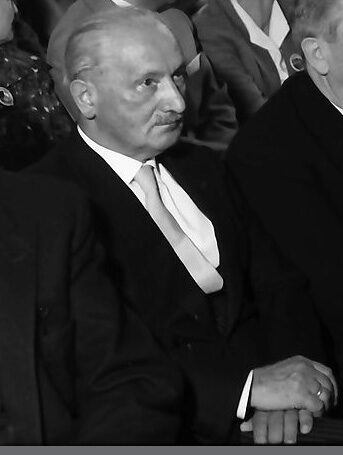
Life
Martin Heidegger in their own century
Heidegger came from a Catholic family in Meßkirch, trained first for the priesthood, and became Husserl's assistant at Freiburg before publishing Being and Time in 1927. He succeeded Husserl in the chair a year later. In 1933 he was elected rector under the new regime, joined the National Socialist party, and gave a rectoral address in its service; he left the rectorate in 1934 but remained a party member until 1945, and was banned from teaching until 1951. He never publicly apologised.
Philosophy in the 1920s had split into a scientific programme that treated everything else as confusion and a Lebensphilosophie that treated science as a thin account of living. Heidegger's move was to refuse both by asking about being itself, a question he said the tradition had forgotten almost as soon as it was raised.
Central ideas
The question of being
Philosophy has asked what kinds of things there are and almost never what it means for anything to be. Heidegger argues that the question was covered over by treating being as though it were itself a very general thing, and that it can only be reopened through the one entity for which its own being is a question, which he calls Dasein.
Being-in-the-world
We do not begin as minds facing a world of objects and then work out how to reach it. We begin already involved: a hammer is not first observed and then used, it is encountered in the using, and only shows up as an object when it breaks. This reversal of the Cartesian picture is what phenomenology looks like in his hands.
Technology as enframing
The later work argues that modern technology is not a set of tools but a way of disclosing everything, ourselves included, as a standing reserve to be ordered and drawn on. The danger he names is not that machines will do harm but that this way of seeing will become the only one available.
Criticism & debate
The politics is not a separable biographical detail: the Black Notebooks, published from 2014, contain antisemitic passages written into the philosophical work itself, and the scholarship has been reassessing how deep that goes ever since. On the philosophy, Carnap argued that his sentences are not false but meaningless, and Adorno attacked the style as a jargon that sounds profound while resisting any test.
Influence
Being and Time stands behind Sartre, Arendt, Gadamer, Levinas and Derrida, several of whom had to work out their relation to the man as well as the book. His account of technology remains one of the few philosophical treatments of the subject that is still read outside philosophy.
How to read them
Begin Martin Heidegger with the tension between the question of being and being-in-the-world. Read the major works slowly enough to notice how biography, public crisis and method shape the argument rather than treating the thinker as a list of doctrines.
If Martin Heidegger is right about the question of being, what habit of judgement would have to change first?
In their words
“The 'essence' of Dasein lies in its existence.”
“Language is the house of Being.”