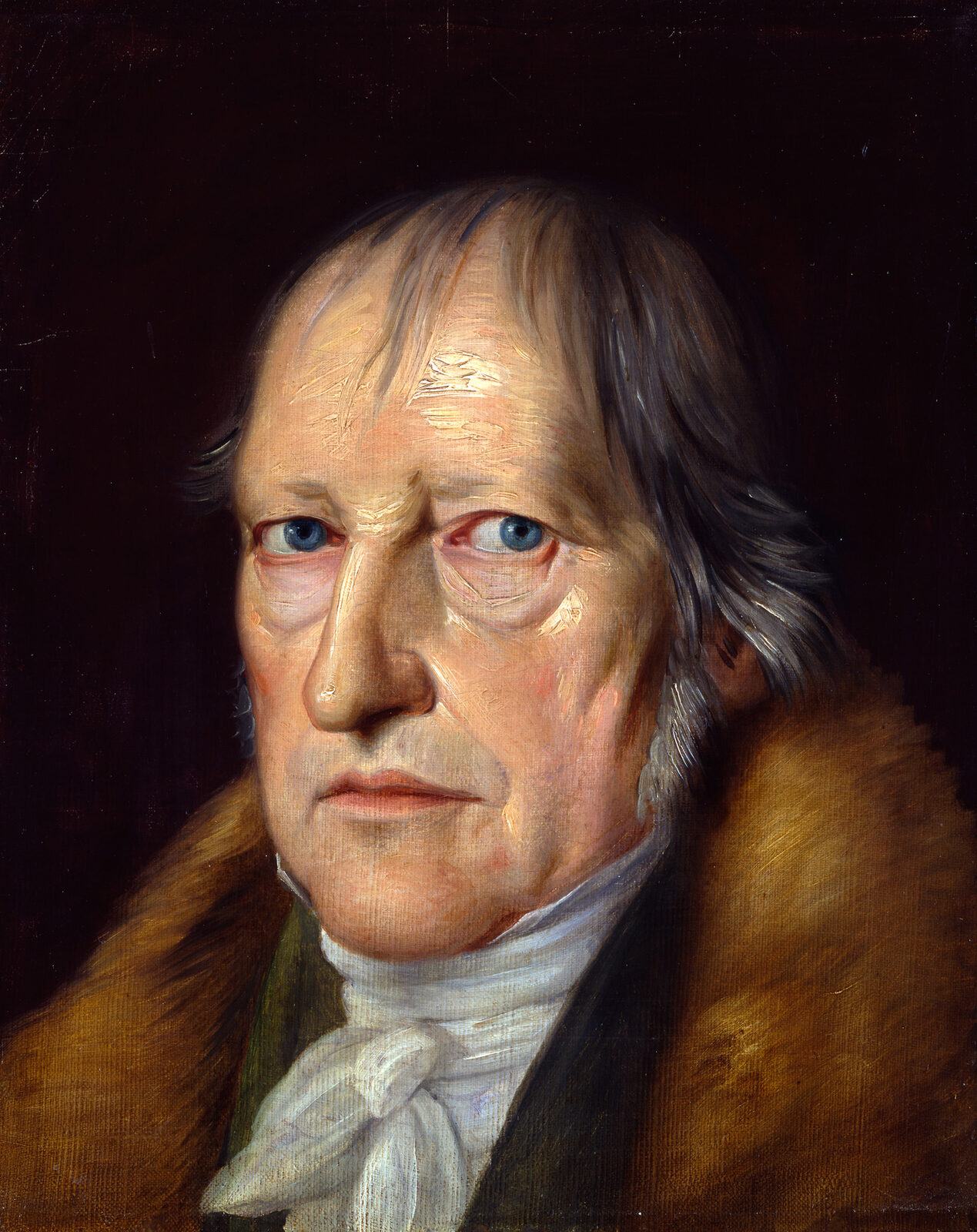
Life
G. W. F. Hegel in their own century
Hegel shared a room at the Tübingen seminary with Hölderlin and Schelling, spent his thirties as a tutor and a newspaper editor, and finished the Phenomenology of Spirit in Jena in 1806 as Napoleon's army entered the town. Recognition came late: he was headmaster of a Nuremberg grammar school until he was forty-six, and only took the Berlin chair in 1818, where he taught until he died in the cholera epidemic of 1831.
He wrote in the aftermath of the French Revolution and inside Kant's settlement, both of which he treated as unfinished. The Revolution had shown freedom asserting itself and then consuming itself; Kant had secured knowledge by placing the thing in itself permanently out of reach. Hegel's whole project is an attempt to show that neither result is final.
Central ideas
Dialectic
A concept pressed hard enough turns out to contain its own opposite, and the contradiction is resolved only by a richer concept that preserves what was true in both. This is not a formula applied from outside; Hegel's claim is that thought does this by itself, and the philosopher's job is to watch rather than to arrange. The textbook triad of thesis, antithesis and synthesis is not his, and he never uses it.
Spirit in history
History, for Hegel, is the process by which spirit becomes conscious of its own freedom, working through institutions, art, religion and philosophy rather than in anyone's intentions. The claim is genuinely double-edged: it makes freedom the point of the story, and it also makes a great deal of suffering look like the cost of an argument.
Recognition
In the passage on lordship and bondage, a self-consciousness discovers that it cannot be certain of itself alone; it needs to be acknowledged by another it also acknowledges. Domination fails on its own terms, since recognition extracted by force is worthless. Almost every later account of identity, dignity and struggle takes something from these few pages.
Criticism & debate
Schopenhauer thought him a charlatan and said so at length. Kierkegaard's objection is more serious: a system that explains everything has no place to put the single existing person who has to choose. Marx accepted the method and rejected the idealism, and Popper later charged him with supplying the intellectual habits of the totalitarian state, a reading that specialists mostly reject but that has stuck.
Influence
Modern philosophy divides around him almost as much as around Kant. Marx, Feuerbach and the Frankfurt School come out of him directly; Kierkegaard and the existentialists come out of rejecting him; and Kojève's Paris lectures on the Phenomenology in the 1930s put him behind Sartre, Beauvoir and much of French thought after them.
How to read them
Begin G. W. F. Hegel with the tension between dialectic and spirit in history. Read the major works slowly enough to notice how biography, public crisis and method shape the argument rather than treating the thinker as a list of doctrines.
If G. W. F. Hegel is right about dialectic, what habit of judgement would have to change first?
In their words
“The owl of Minerva begins its flight only with the onset of dusk.”
“What is rational is actual; and what is actual is rational.”
“Self-consciousness exists in and for itself when, and by the fact that, it so exists for another.”