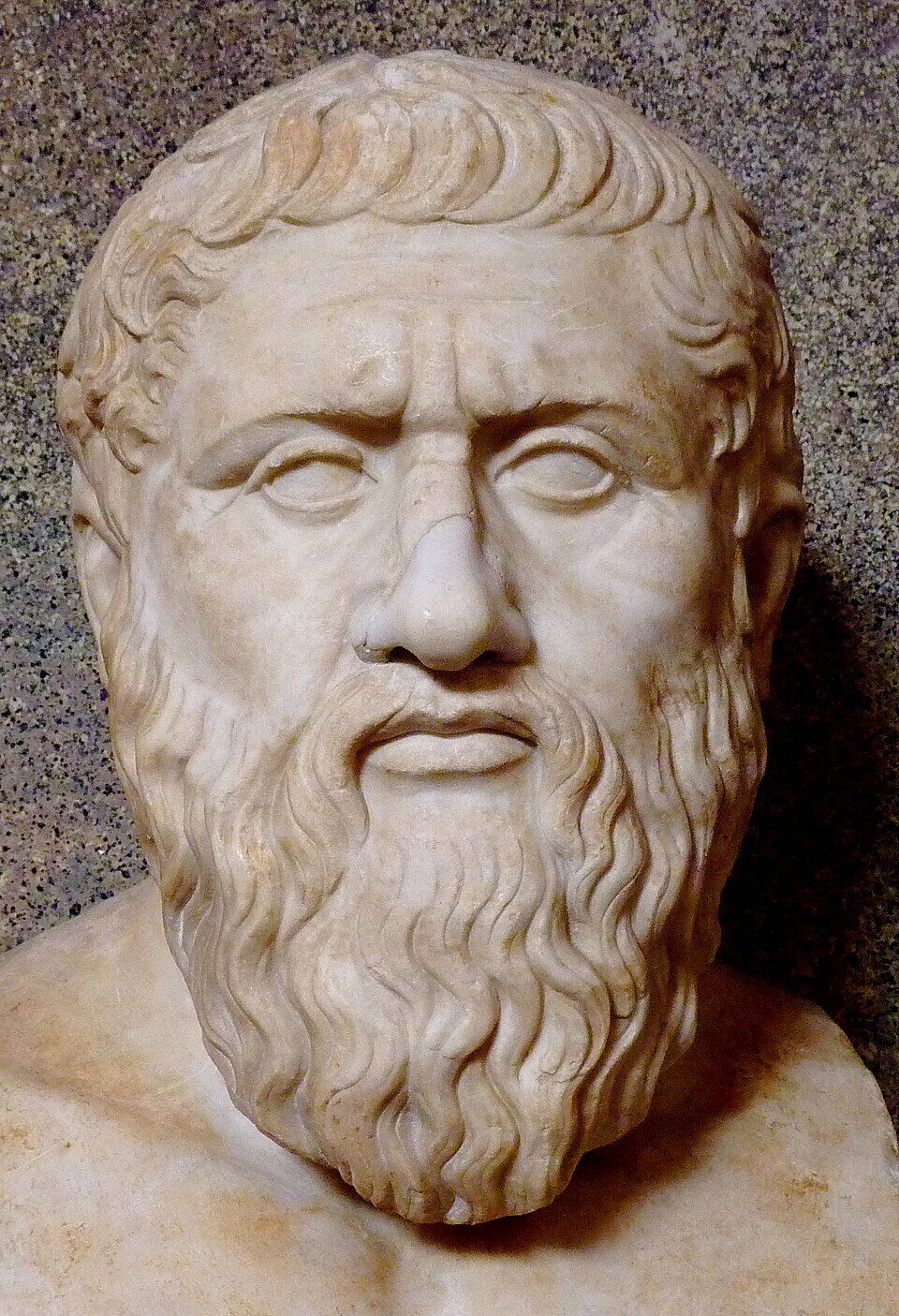
Life
Plato in their own century
Born into an aristocratic Athenian family, Plato turned from politics after the execution of Socrates, travelled in Italy and Sicily, and founded the Academy at Athens around 387 BCE, where he taught and wrote for four decades.
He wrote for a defeated democracy that had killed his teacher, and his political proposals should be read against repeated Athenian experiments with rule by assembly, by oligarchs and by tyrants.
Central ideas
Theory of Forms
Particular beautiful or just things change and conflict; Plato argues that what we understand when we judge them are stable Forms, known by thought rather than by sight.
Dialectic
Knowledge advances through disciplined conversation that tests hypotheses, rather than through rhetoric, which persuades without securing understanding.
Philosopher-rulers
If ruling well is a kind of expertise, then power should follow knowledge of the good — a claim he presses in the Republic and tries, unsuccessfully, to advise on in Syracuse.
Criticism & debate
Aristotle argued that separated Forms duplicate the world without explaining it. Modern readers, Karl Popper most sharply, attack the Republic’s censorship, rigid classes and rule by an unaccountable elite.
Influence
Almost every later tradition negotiates with him: Neoplatonism, Augustine’s theology, Renaissance humanism, and modern debates on mathematics and universals.
How to read them
Begin Plato with the tension between theory of forms and dialectic. Read the major works slowly enough to notice how biography, public crisis and method shape the argument rather than treating the thinker as a list of doctrines.
If Plato is right about theory of forms, what habit of judgement would have to change first?
In their words
“Love is the desire for the perpetual possession of the good.”
“Until philosophers rule as kings, cities will have no rest from evils.”
“Those who pursue philosophy aright study nothing but dying and being dead.”