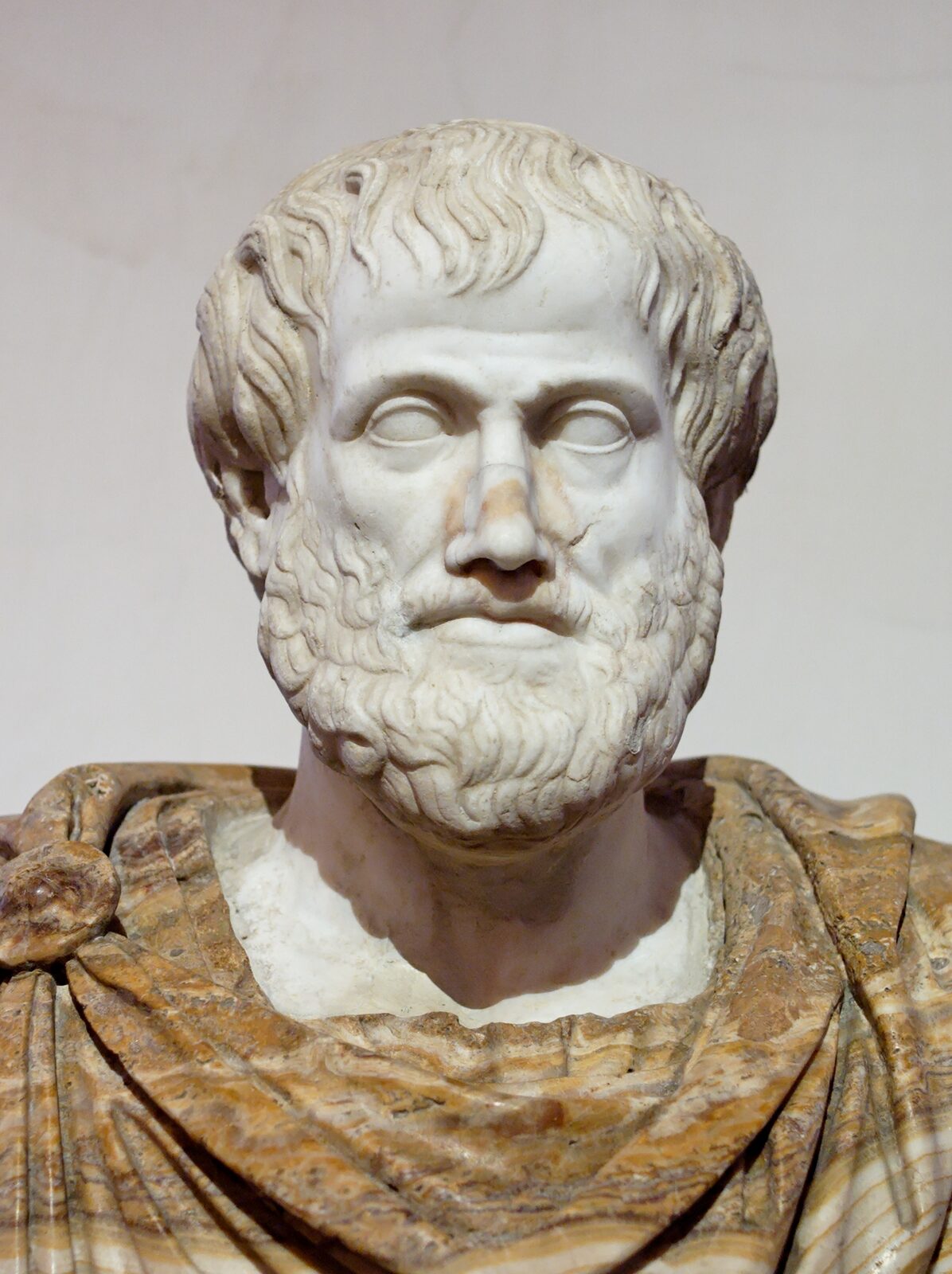
Life
Aristotle in their own century
Born at Stagira, Aristotle studied at Plato’s Academy for twenty years, tutored the young Alexander in Macedon, and founded the Lyceum in Athens in 335 BCE. Anti-Macedonian feeling drove him from the city in 323 BCE.
His research programme — collecting constitutions, dissecting animals, cataloguing arguments — belongs to a Greek world newly opened by Macedonian expansion and its flow of specimens and information.
Central ideas
Virtue ethics
Goodness is not a rule but a settled disposition: courage or generosity is a trained mean between excess and deficiency, formed by repeated action.
Four causes
To explain a thing he asks four questions — what it is made of, what form it has, what brought it about, and what it is for — and insists purpose belongs in a full explanation.
Practical wisdom
Phronesis is the capacity to judge what this situation requires; it cannot be replaced by a formula, which is why ethics is not an exact science.
Criticism & debate
His physics and biology were superseded, and his defences of slavery and of women’s subordination are indefensible; his teleology was a chief target of the scientific revolution.
Influence
Transmitted through Ibn Rushd and Aquinas, he became “the Philosopher” of medieval Europe. Virtue ethics returned to the centre of moral philosophy in the twentieth century largely through rereadings of him.
How to read them
Begin Aristotle with the tension between virtue ethics and four causes. Read the major works slowly enough to notice how biography, public crisis and method shape the argument rather than treating the thinker as a list of doctrines.
If Aristotle is right about virtue ethics, what habit of judgement would have to change first?
In their words
“Man is by nature a political animal.”
“Happiness is an activity of the soul in accordance with virtue.”
“We become just by doing just acts, temperate by doing temperate acts.”