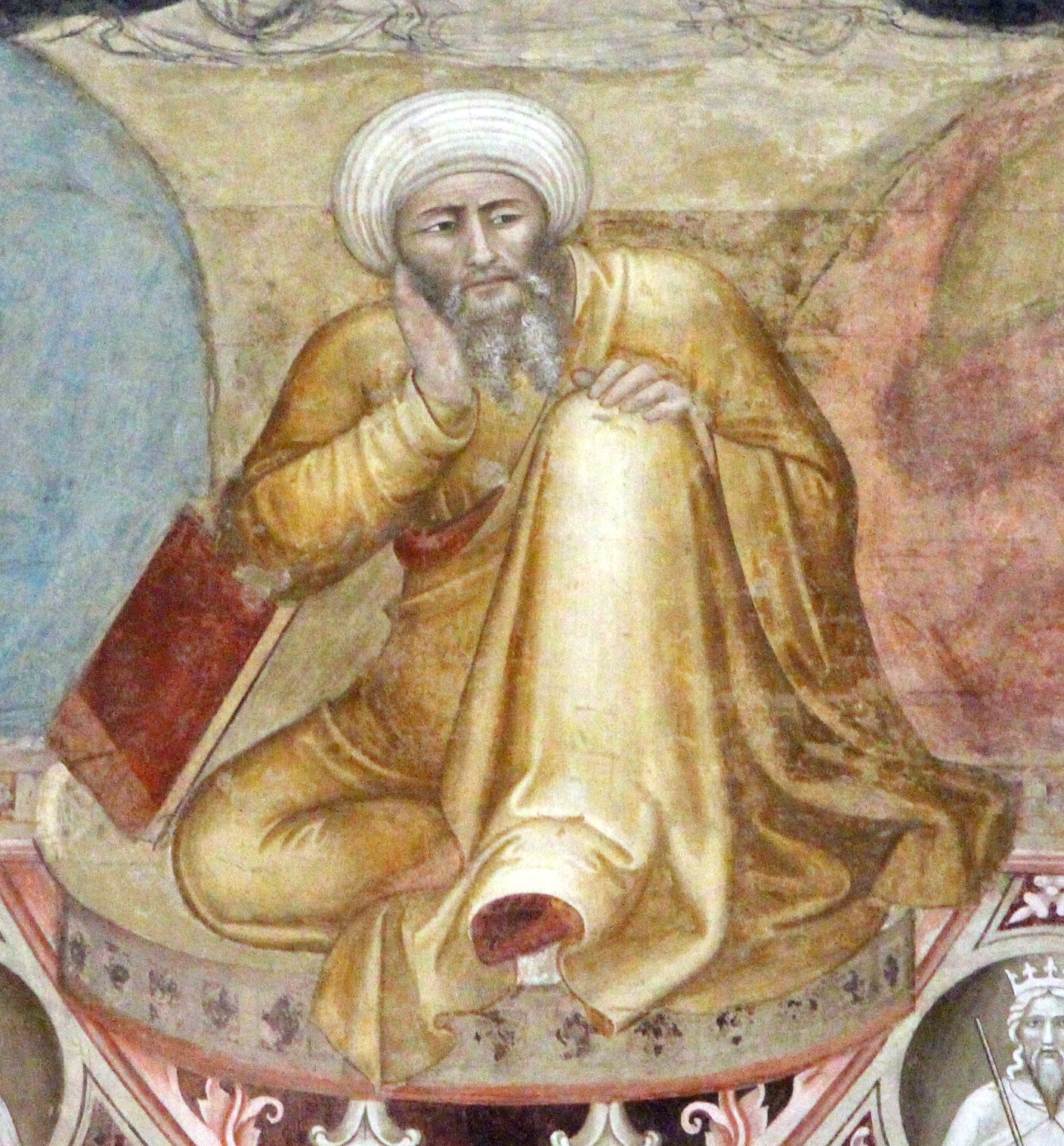
Life
Averroes (Ibn Rushd) in their own century
Ibn Rushd was born in Córdoba into a family of jurists; his grandfather and father had both been chief judge of the city. He held the same office, served as physician to the Almohad caliph Abu Yaqub Yusuf, and wrote commentaries on almost the whole Aristotelian corpus at three different lengths, for three different kinds of reader. Late in life he was disgraced and briefly banished to Lucena. He died in Marrakesh in 1198.
Almohad al-Andalus was a place where a judge could also be the caliph's philosopher, and where that position could be withdrawn without warning. The problem he worked on, whether the study of philosophy is lawful for a Muslim, was not abstract: it determined whether the books could be written at all.
Central ideas
The Commentator
He wrote short, middle and long commentaries on Aristotle, the long ones quoting the text in full and working through it phrase by phrase. Latin readers called him simply the Commentator, and for two centuries reading Aristotle in Europe largely meant reading Aristotle through him.
Two idioms, one truth
The Decisive Treatise argues, as a legal ruling rather than a plea, that scripture commands reflection on creation, that demonstration is the highest form of reflection, and that revelation and demonstration cannot conflict because both are true. Where the apparent sense of a text contradicts a demonstration, the text is to be interpreted.
The single intellect
Reading Aristotle on the intellect, he concluded that the material intellect is one and the same for all human beings rather than individual to each. Latin scholastics saw at once that this appears to leave nothing personal to survive death, and it was among the propositions condemned at Paris in 1270 and 1277.
Criticism & debate
His reply to al-Ghazali defends Aristotle so closely that critics have asked whether he is arguing for the truth or for his author. The doctrine of the single intellect drew the sharpest response: Aquinas wrote a treatise against it, and the Latin Averroists who took it up were condemned rather than answered.
Influence
He was read more in Latin and Hebrew than in Arabic after his death. Siger of Brabant built on him, Aquinas argued with him on almost every page, Dante placed him in Limbo among the virtuous pagans, and Renaissance Padua was still teaching him in the sixteenth century.
How to read them
Begin Averroes (Ibn Rushd) with the tension between the commentator and two idioms, one truth. Read the major works slowly enough to notice how biography, public crisis and method shape the argument rather than treating the thinker as a list of doctrines.
If Averroes (Ibn Rushd) is right about the commentator, what habit of judgement would have to change first?