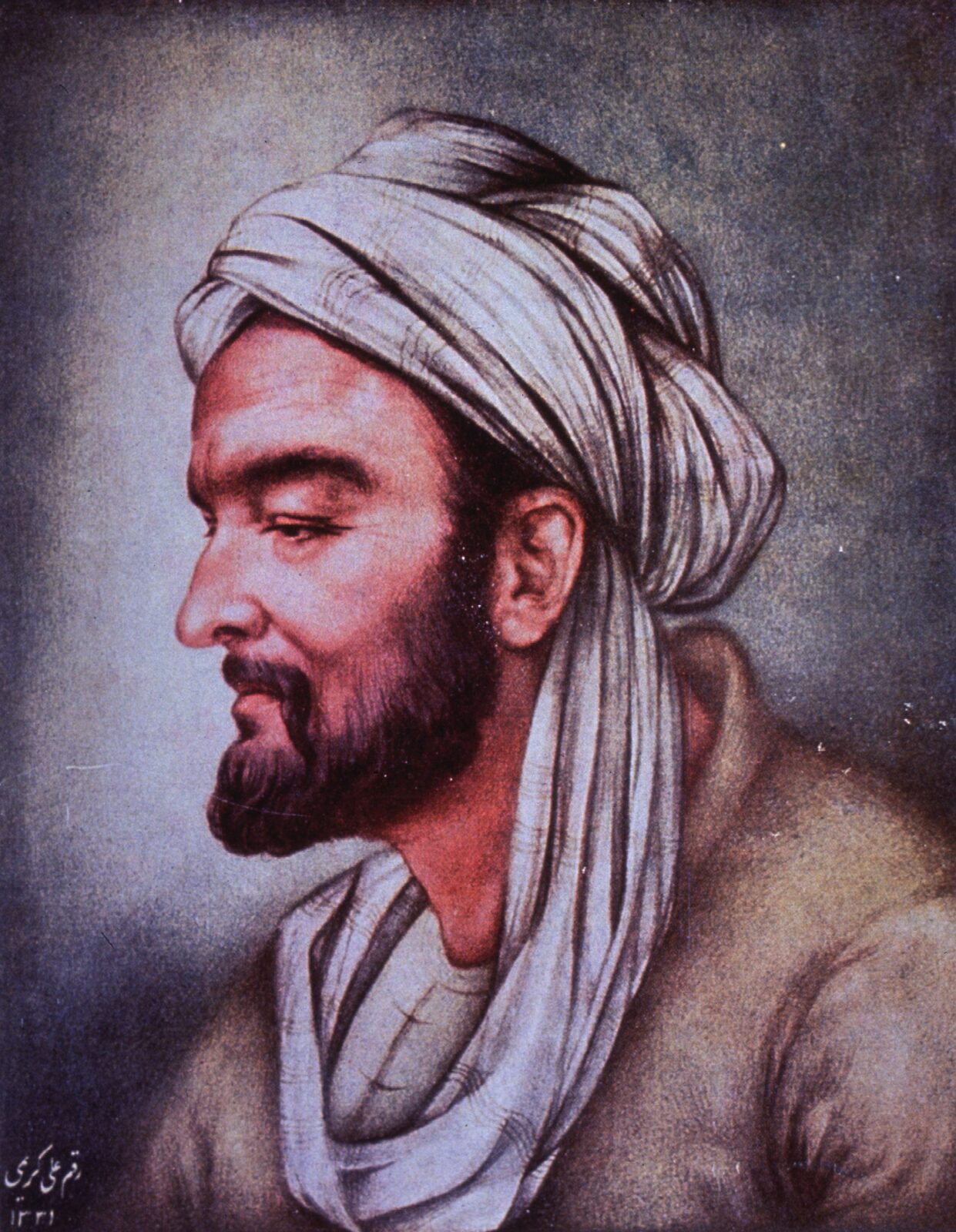
Life
Avicenna (Ibn Sina) in their own century
Ibn Sina grew up near Bukhara, read his way through the sciences as a teenager, and was treating patients at the Samanid court before he was twenty. The rest of his life was spent moving between the courts of a fragmenting eastern Iran, serving as physician and sometimes as vizier, writing at night and occasionally in prison. He died near Hamadan in 1037.
He wrote a generation after the great translations, in a world where the Greek inheritance was no longer news but material to be rebuilt. His Canon of Medicine organised Greek and Arabic medicine into a system so usable that it was still being taught in European universities in the seventeenth century, which is part of why his philosophical work travelled so far.
Central ideas
Essence and existence
What a thing is can be grasped without knowing whether it exists: you can understand triangle without knowing that any triangle is. Existence is therefore something added to an essence rather than contained in it, a distinction that arrives in Latin as the difference between essentia and esse.
The necessary existent
Everything whose existence is merely possible needs something outside itself to account for it. A chain of such things, however long, is still a chain of borrowers, so there must be something whose essence is to exist. The argument runs from contingency rather than from motion, and Aquinas takes it up directly.
The floating man
Suppose a person created in mid-air, in the dark, limbs apart, touching nothing. Ibn Sina argues that they would still affirm that they exist, while affirming nothing about a body. The thought experiment is meant to show that self-awareness is not derived from the senses, and it anticipates Descartes by six centuries.
Criticism & debate
Al-Ghazali devoted The Incoherence of the Philosophers to him, charging that the eternity of the world, the denial that God knows particulars, and the denial of bodily resurrection put the philosophers outside Islam. Within philosophy the sharper objection is that the distinction between essence and existence may be a fact about how we think of things rather than about the things.
Influence
He became the philosopher to argue with. Al-Ghazali attacked him, Averroes defended Aristotle against him, and in Latin he shaped Aquinas, Duns Scotus and the whole scholastic vocabulary of being.
How to read them
Begin Avicenna (Ibn Sina) with the tension between essence and existence and the necessary existent. Read the major works slowly enough to notice how biography, public crisis and method shape the argument rather than treating the thinker as a list of doctrines.
If Avicenna (Ibn Sina) is right about essence and existence, what habit of judgement would have to change first?