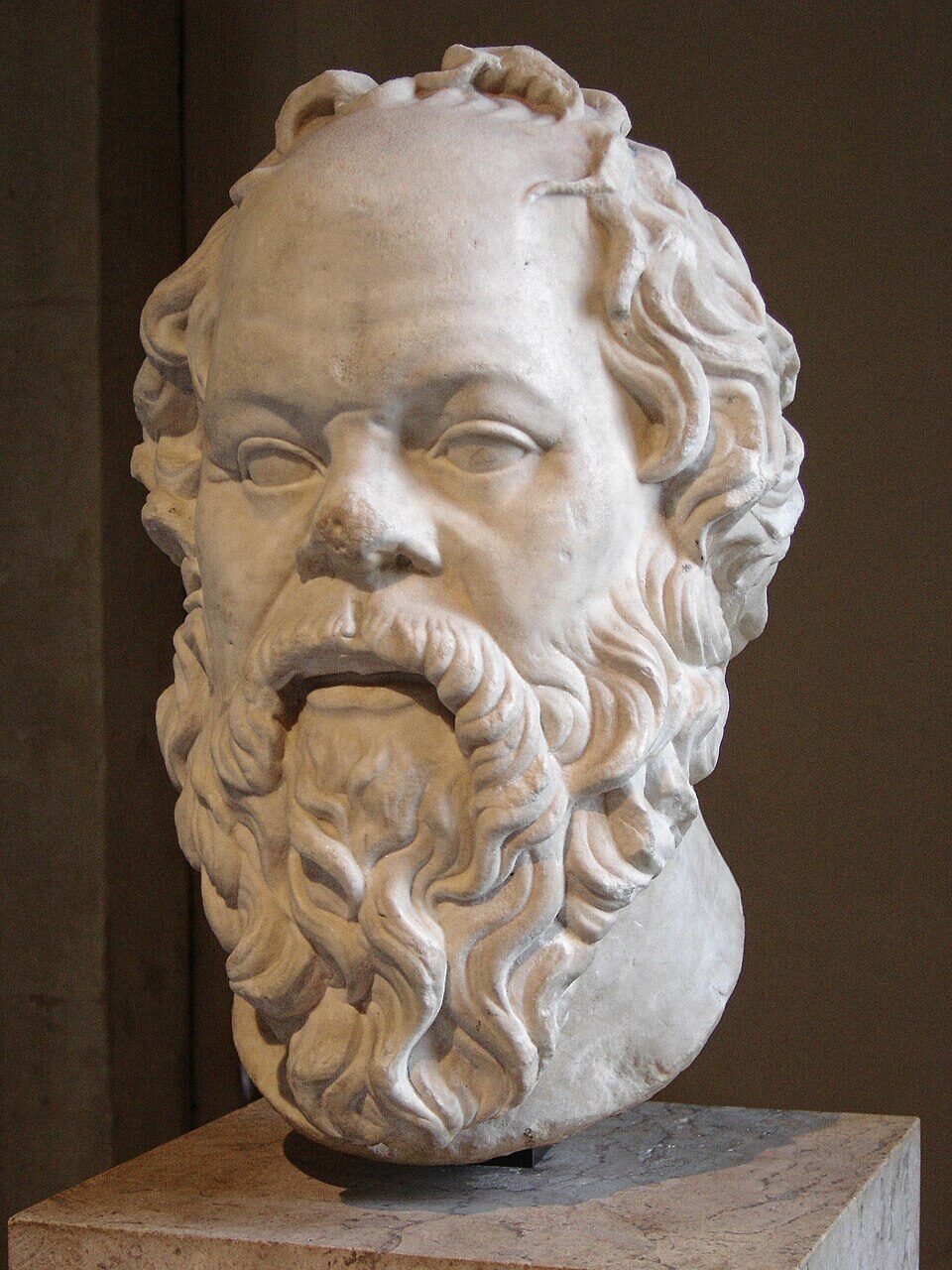
Life
Socrates in their own century
Socrates lived his whole life in Athens, served as a hoplite at Potidaea and Delium, and spent his days questioning craftsmen, politicians and poets in the agora rather than teaching for a fee. In 399 BCE an Athenian jury convicted him of impiety and corrupting the young, and he was executed by hemlock.
His adult years span the Peloponnesian War, plague, oligarchic coups and the restored democracy — a city losing confidence in its own institutions, which made a public questioner both compelling and dangerous.
Central ideas
Socratic inquiry
Rather than asserting doctrines, he asked for definitions and then tested them against his interlocutor’s own further beliefs, so that contradictions surfaced from within.
Ethical self-examination
He treated the care of one’s soul — how one actually lives — as more urgent than reputation, office or wealth, and argued that no one willingly harms themselves by wrongdoing.
Intellectual humility
His claim to know only his own ignorance is not modesty for its own sake but a working method: unexamined confidence is the main obstacle to learning.
Criticism & debate
Because he left no writings, every portrait is mediated: Plato’s Socrates, Xenophon’s and Aristophanes’ differ sharply, and scholars still dispute which arguments are his. Critics also note that his cross-examinations often end in impasse without offering guidance on how to live.
Influence
Plato’s dialogues made him the founding figure of Western philosophy, and later Stoics, Cynics and Sceptics all claimed him. The word “Socratic” still names a style of teaching by question.
How to read them
Begin Socrates with the tension between socratic inquiry and ethical self-examination. Read the major works slowly enough to notice how biography, public crisis and method shape the argument rather than treating the thinker as a list of doctrines.
If Socrates is right about socratic inquiry, what habit of judgement would have to change first?
In their words
“The unexamined life is not worth living.”
“What I do not know, I do not think I know either.”