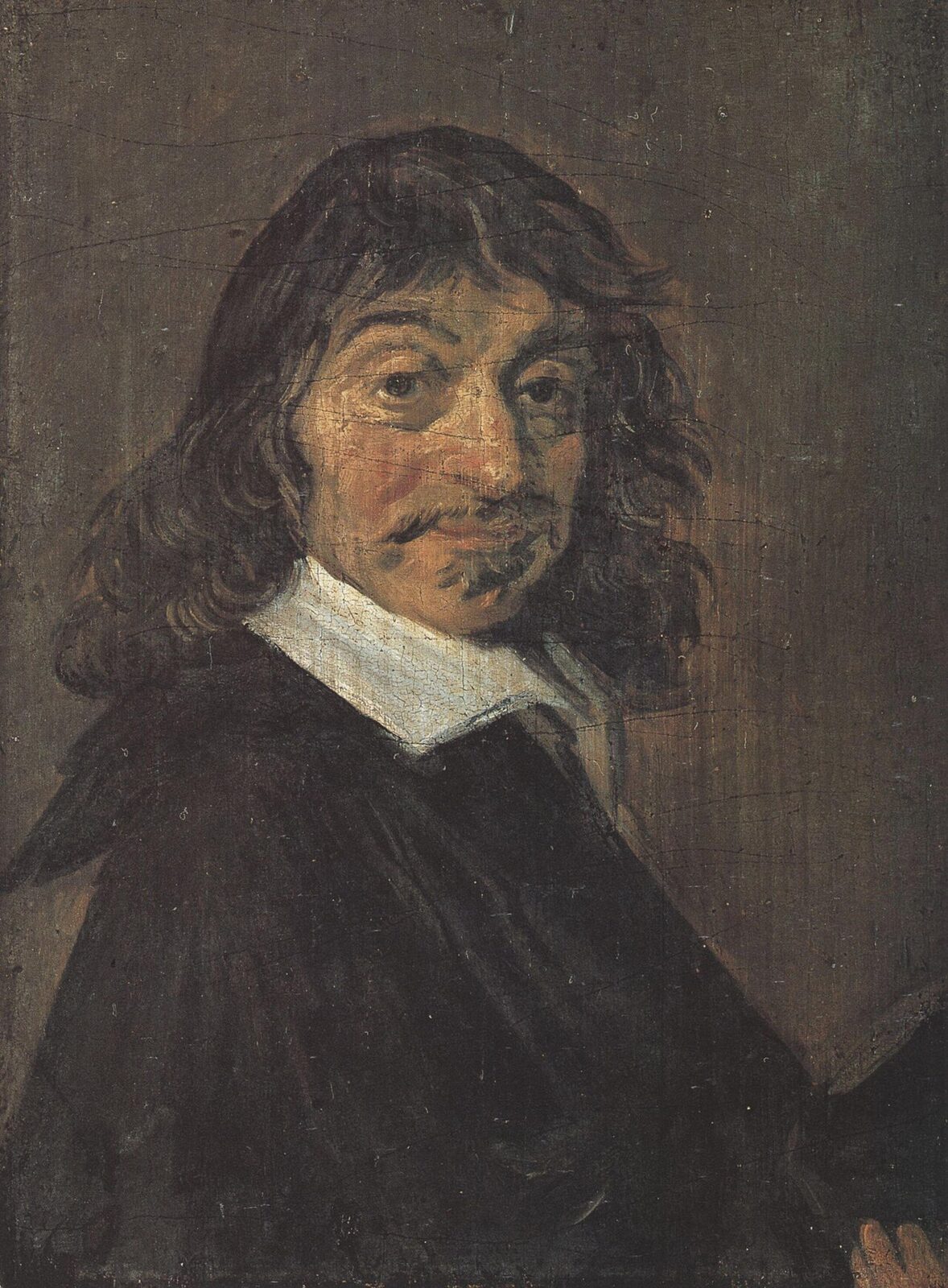
Life
René Descartes in their own century
Educated by Jesuits at La Flèche, Descartes served briefly as a soldier, then settled in the Dutch Republic where he wrote his major works. He died in Stockholm in 1650, having come to tutor Queen Christina.
Galileo’s condemnation in 1633 led him to withhold his own physics; his philosophy is built to secure the new mathematical science without a direct collision with the Church.
Central ideas
Methodic doubt
Doubt is used as an instrument, not a conclusion: he suspends everything that could conceivably be false in order to find what cannot be.
Cogito
Even universal deception leaves the thinking itself, which gives him a first certainty from which to rebuild knowledge.
Mind-body dualism
He concludes that thought and extension are distinct kinds of substance — a division that made mechanical physics tractable and the mind-body problem permanent.
Criticism & debate
Elisabeth of Bohemia asked how an unextended mind could move a body, and no Cartesian answer satisfied; later critics attack the cogito’s move from thinking to a thinking substance, and the circularity of proving God to validate reason.
Influence
He set the agenda of modern epistemology; Spinoza, Leibniz, Locke and Kant all define themselves partly against him, and analytic geometry bears his name.
How to read them
Begin René Descartes with the tension between methodic doubt and cogito. Read the major works slowly enough to notice how biography, public crisis and method shape the argument rather than treating the thinker as a list of doctrines.
If René Descartes is right about methodic doubt, what habit of judgement would have to change first?
In their words
“I think, therefore I am.”
“Divide each of the difficulties under examination into as many parts as possible.”