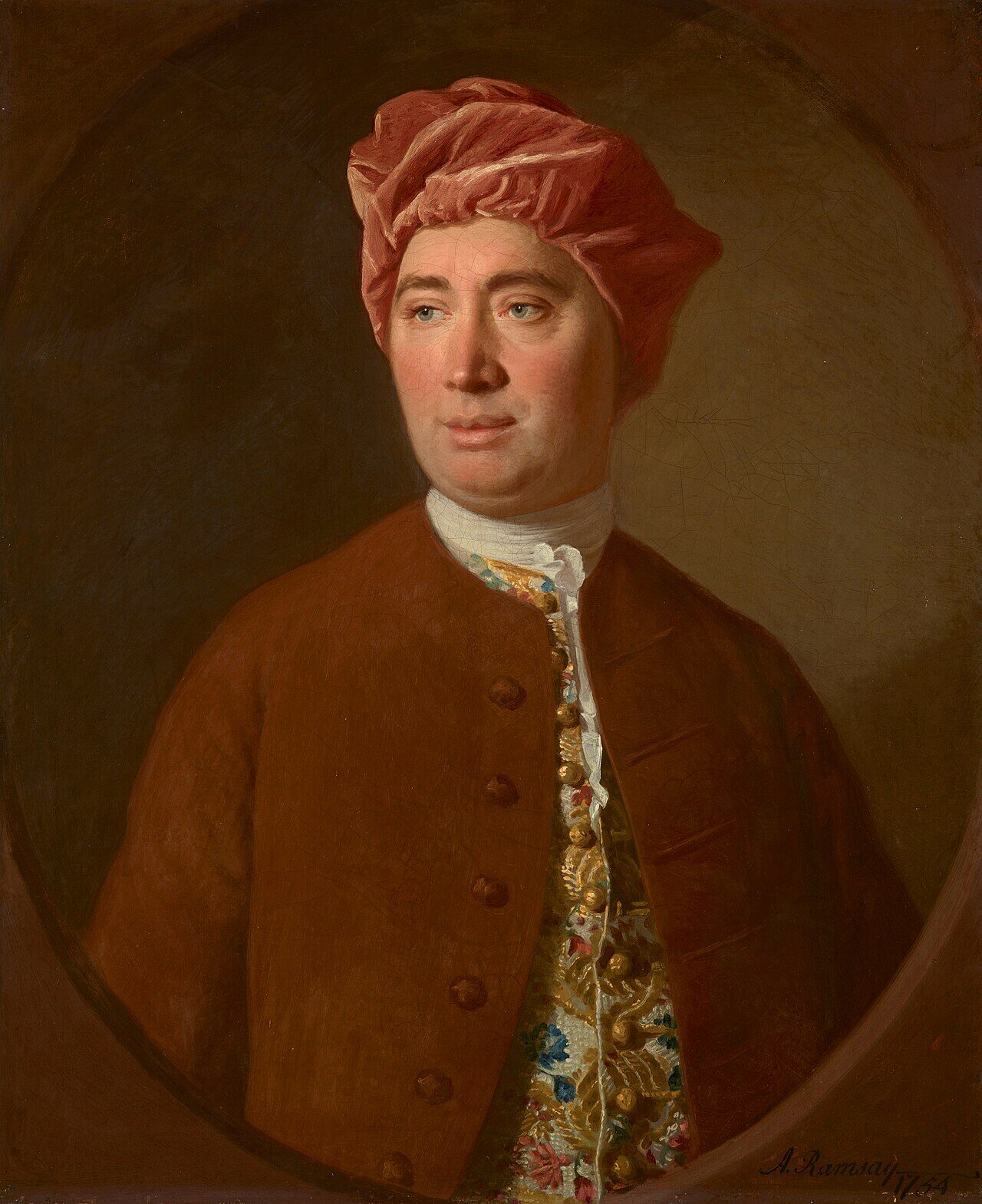
Life
David Hume in their own century
An Edinburgh lawyer’s son, Hume wrote the Treatise in his twenties to little reception, made his living as librarian, tutor, historian and diplomat, and became the most celebrated author of the Scottish Enlightenment — while being twice refused a university chair for irreligion.
Post-Union Edinburgh combined Presbyterian orthodoxy with a booming club and print culture, which explains both his caution about publishing on religion and the conversational polish of his prose.
Central ideas
Problem of induction
No observation of past regularity can demonstrate that the future will resemble it; our confidence in causes is habit, reasonable to act on but not provable.
Bundle theory
Introspection finds a succession of perceptions and no separate self standing behind them.
Moral sentiment
Moral distinctions arise from sentiment rather than reason alone, and no description of how things are yields, by itself, a conclusion about what ought to be.
Criticism & debate
Kant held that experience already presupposes the causal structure Hume dissolved; Reid objected that his scepticism refutes common sense, and his published remarks on race are racist and were criticised in his own century.
Influence
He woke Kant from “dogmatic slumber”, founded naturalistic ethics and philosophy of religion, and remains the reference point for induction, causation and the is-ought gap.
How to read them
Begin David Hume with the tension between problem of induction and bundle theory. Read the major works slowly enough to notice how biography, public crisis and method shape the argument rather than treating the thinker as a list of doctrines.
If David Hume is right about problem of induction, what habit of judgement would have to change first?
In their words
“Reason is, and ought only to be, the slave of the passions.”
“A wise man proportions his belief to the evidence.”
“Custom, then, is the great guide of human life.”