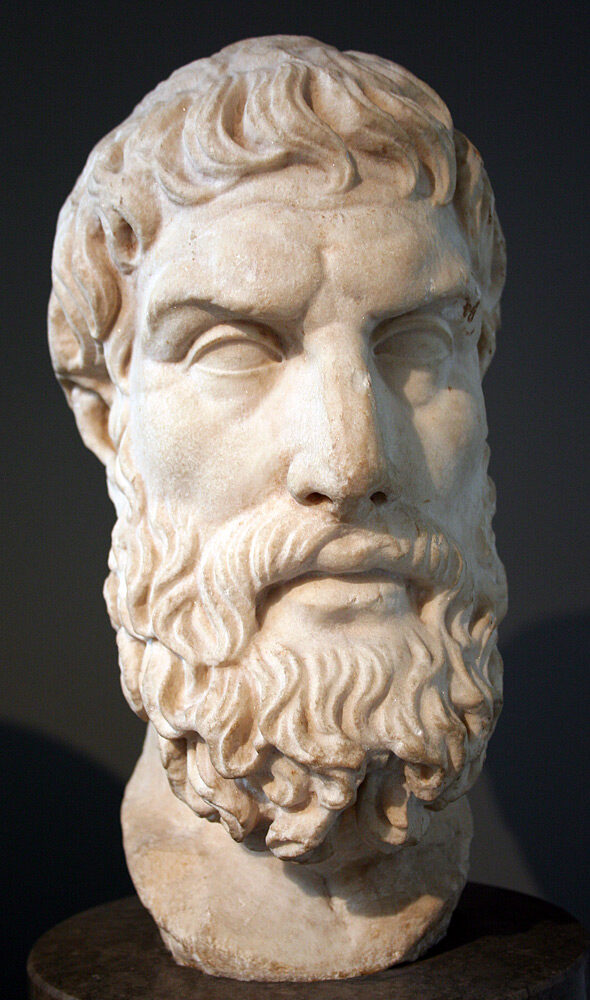
Life
Epicurus in their own century
Raised on Samos, Epicurus taught in Asia Minor before buying a garden outside Athens around 307 BCE, where he lived with a community that unusually included women and enslaved people as members.
After Alexander, civic politics offered Greeks less real power; Hellenistic schools shifted attention from the city to the management of a life, and Epicurus’ withdrawal was a considered response, not mere escape.
Central ideas
Ataraxia
The goal is the absence of bodily pain and mental disturbance, a stable state, rather than the accumulation of intense sensations.
Simple pleasure
He sorts desires into natural and necessary, natural but unnecessary, and empty, and argues that bread, water and friends satisfy the first class cheaply.
Freedom from fear
Because the soul is atomic and dissolves at death, death is not an experience that can harm us; fear of the gods and of the afterlife is removed by physics, not by consolation.
Criticism & debate
Ancient rivals accused the school of shirking civic duty, and Christian writers turned “epicure” into an insult for sensuality — the opposite of his actual counsel. Critics still ask whether tranquility is an ambitious enough goal.
Influence
Lucretius carried the physics into Latin poetry; the rediscovery of On the Nature of Things shaped early modern atomism, and his account of pleasure informs modern hedonistic ethics.
How to read them
Begin Epicurus with the tension between ataraxia and simple pleasure. Read the major works slowly enough to notice how biography, public crisis and method shape the argument rather than treating the thinker as a list of doctrines.
If Epicurus is right about ataraxia, what habit of judgement would have to change first?
In their words
“Let no one be slow to seek wisdom when he is young nor weary in the search thereof when he is grown old.”
“Death is nothing to us; for what has dissolved has no sensation.”
“It is impossible to live pleasantly without living prudently and honorably and justly.”