Rationalism
Reason as a principal source of knowledge.
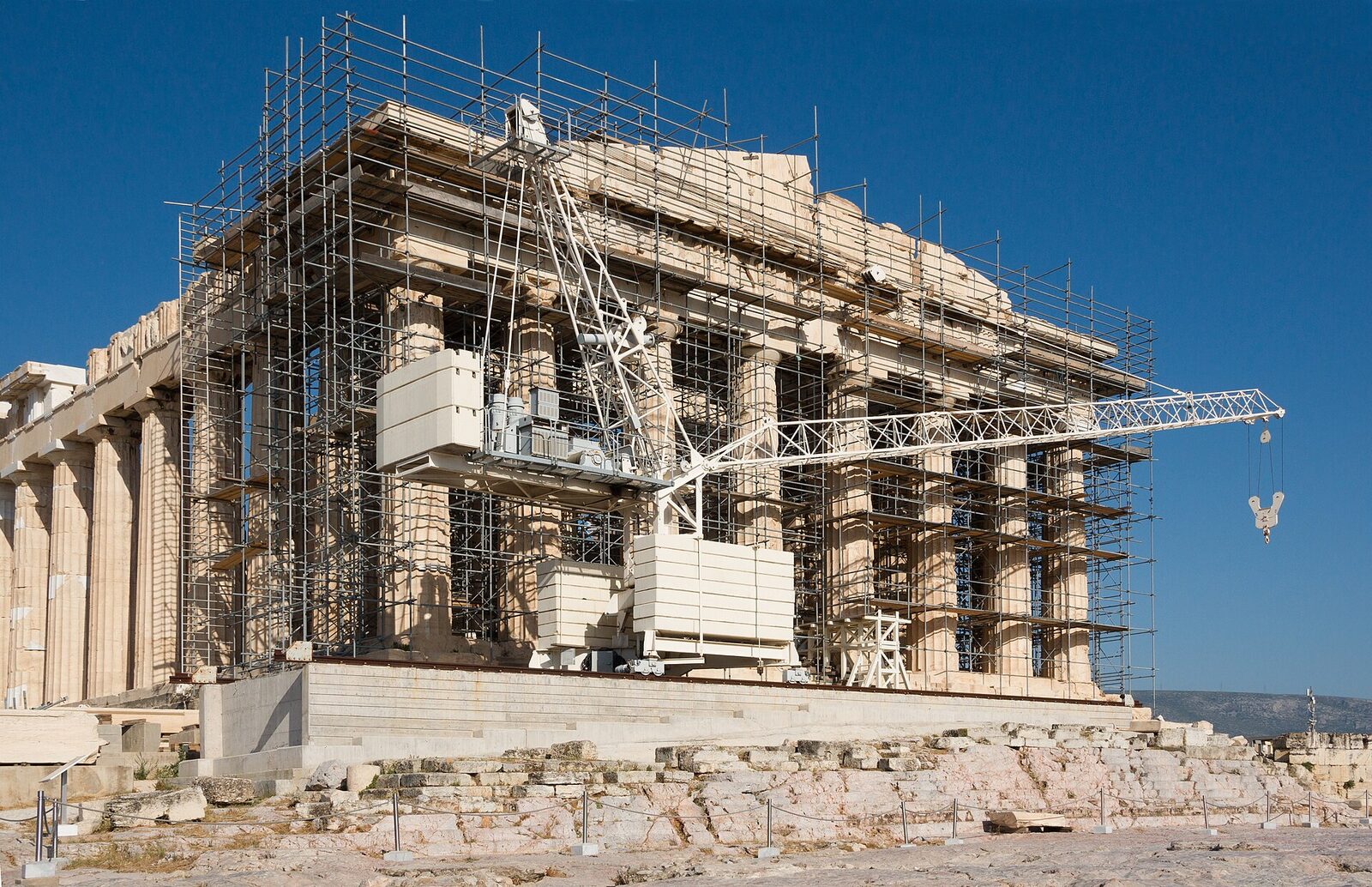
Parthenon, Acropolis of Athens, restoration work at the western facade (photo Jebulon, 2015, CC0)
Origin
Central to 17th-century European philosophy: Descartes, Spinoza, Leibniz.
Central claims
- Reason can secure knowledge independent of sensory experience.
- Some ideas and principles are innate or self-evident.
- Reality has an intelligible, necessary structure.
Criticism
Empiricists reply that claims about innate ideas are unverifiable and that pure reason alone yields no substantive knowledge of the world.
Development
Early modern rationalists sought certainty after scholastic conflict and scientific revolution. Mathematics supplied a model of clarity, but their systems were not merely mathematical; they were attempts to show that reality itself is intelligible.
Legacy
Rationalism remains present whenever philosophy asks whether reason can discover necessity, whether minds contain structures not learned from sense experience, and whether explanation must reach beyond observation.
In their words
“I think, therefore I am.”
“A free man thinks of death least of all things.”
“Blessedness is not the reward of virtue but virtue itself.”