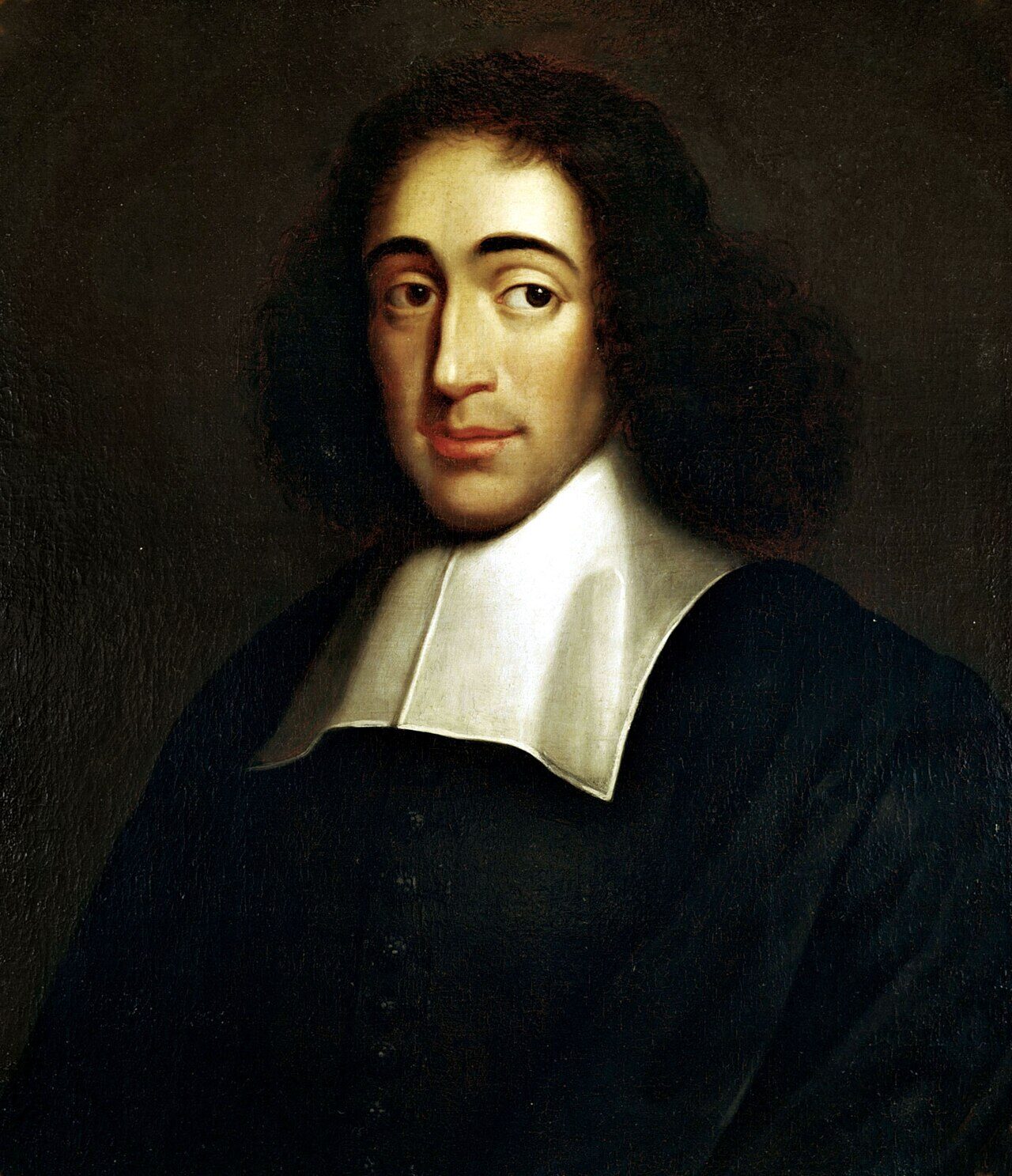
Life
Baruch Spinoza in their own century
Born in Amsterdam to a Portuguese-Jewish family, Spinoza was expelled from his community in 1656 for his views, ground optical lenses for a living, declined a professorship at Heidelberg, and published the Ethics only after his death.
The Dutch Republic’s relative tolerance made his work possible and its religious politics made it dangerous; the Theological-Political Treatise appeared anonymously and was swiftly banned.
Central ideas
Substance monism
There is only one substance, God or Nature, of which minds and bodies are modes — so nature is not made by something outside it.
Necessity
Nothing is contingent: everything follows from the divine nature, which means chance and miracle drop out of his account of the world.
Freedom through understanding
Freedom is not uncaused choice but adequate understanding of the causes that move us; grasping an emotion’s cause changes its hold.
Criticism & debate
Contemporaries called him an atheist and his system fatalistic; critics still object that identifying God with nature empties both terms, and that his determinism leaves moral responsibility unclear.
Influence
Condemned for a century, then claimed by Goethe, Hegel, Nietzsche and Einstein; his biblical criticism helped found modern scholarship and his monism informs current philosophy of mind.
How to read them
Begin Baruch Spinoza with the tension between substance monism and necessity. Read the major works slowly enough to notice how biography, public crisis and method shape the argument rather than treating the thinker as a list of doctrines.
If Baruch Spinoza is right about substance monism, what habit of judgement would have to change first?
In their words
“A free man thinks of death least of all things.”
“Blessedness is not the reward of virtue but virtue itself.”
“The more we understand particular things, the more do we understand God.”