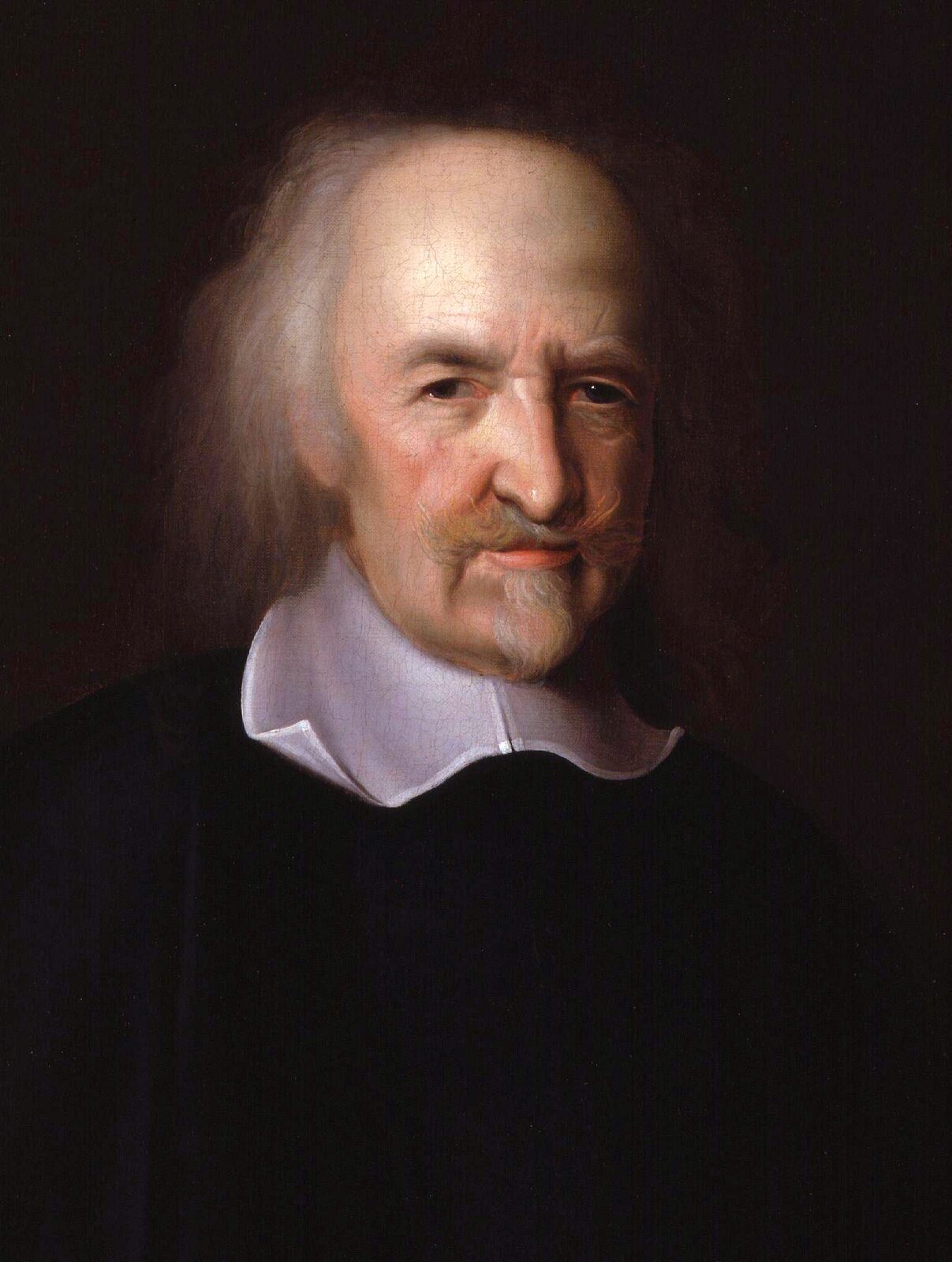
Life
Thomas Hobbes in their own century
Born in the year of the Spanish Armada, Hobbes was educated at Oxford and spent much of his life as tutor and secretary to the Cavendish family. The English Civil War sent him into exile in Paris, where Leviathan was written in the shadow of religious conflict and political collapse.
His philosophy answers a world in which appeals to conscience, church and ancient liberty had produced civil war. He strips politics down to bodies in motion, fear of violent death, and the rational bargain that creates sovereignty.
Central ideas
State of nature
The state of nature is a thought experiment, not a prehistoric report: without common authority, even reasonable people have reason to distrust and pre-empt one another.
Sovereignty
A sovereign must be strong enough to settle disputes decisively; divided authority returns society toward conflict by making final judgement uncertain.
Materialism
Hobbes treats perception, desire and reasoning as motions in matter, giving his political theory a deliberately anti-scholastic, mechanistic foundation.
Criticism & debate
Critics argue that his sovereign is too absolute, that fear cannot be the sole ground of obligation, and that his account leaves little room for rights against the state once authority is instituted.
Influence
Every later social-contract theorist, including Locke, Rousseau and Rawls, writes in his shadow, often by trying to preserve consent without accepting Hobbesian absolutism.
How to read them
Begin Thomas Hobbes with the tension between state of nature and sovereignty. Read the major works slowly enough to notice how biography, public crisis and method shape the argument rather than treating the thinker as a list of doctrines.
If Thomas Hobbes is right about state of nature, what habit of judgement would have to change first?
In their words
“The life of man: solitary, poor, nasty, brutish, and short.”