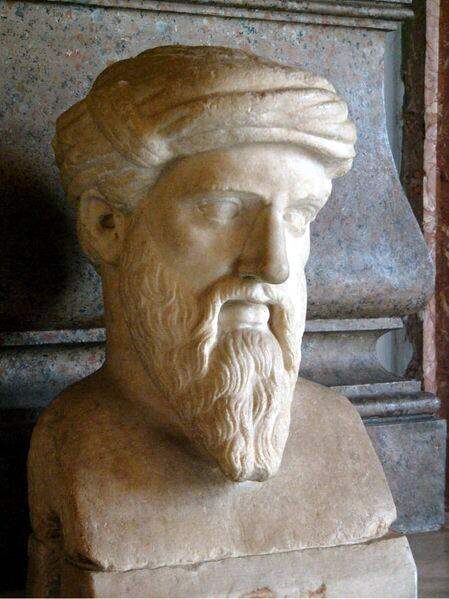
Life
Pythagoras in their own century
Pythagoras left Samos and settled at Croton, where a community formed around his teaching with rules for diet, property, silence and daily conduct. He wrote nothing, and political violence in the Italian cities later scattered the movement.
Ionia was under pressure from Lydia and then Persia, and emigration westward was common. What formed at Croton was closer to a religious order than to a school: enquiry and a way of life were not separate things.
Central ideas
Transmigration of souls
The soul survives death and is reborn into other bodies, human and animal, which turned the treatment of animals into a moral question.
Number and harmony
Musical intervals answer to simple whole-number ratios. The Pythagorean tradition generalised this into the claim that number underlies the order of things.
Philosophy as a way of life
Membership meant a regime: restrictions on food, silence for newcomers, shared property in some accounts, and examination of one's own day before sleep.
Criticism & debate
Almost nothing can be assigned to Pythagoras himself rather than to later Pythagoreans. The theorem that carries his name was in use in Babylon a thousand years earlier, and the detailed biographies date from the Roman period.
Influence
Plato's mathematics-first picture of reality, the medieval quadrivium, and every later attempt to read the cosmos as harmony draw on the Pythagorean tradition.
How to read them
Begin Pythagoras with the tension between transmigration of souls and number and harmony. Read the major works slowly enough to notice how biography, public crisis and method shape the argument rather than treating the thinker as a list of doctrines.
If Pythagoras is right about transmigration of souls, what habit of judgement would have to change first?