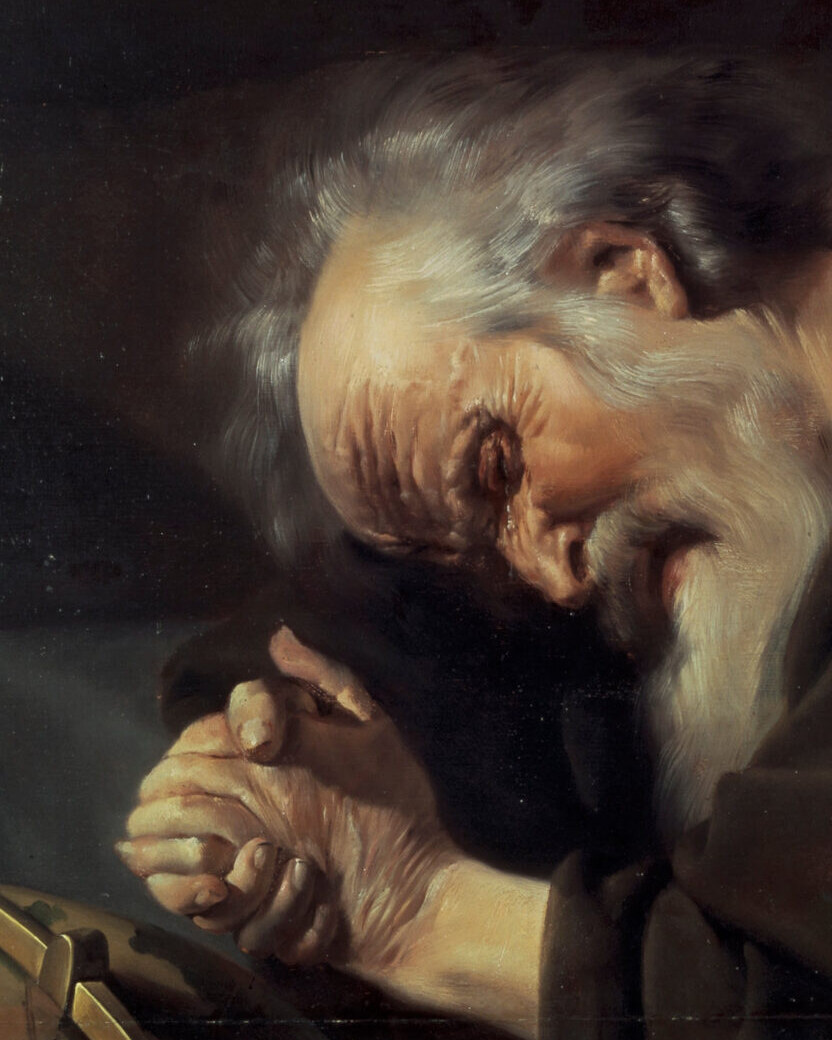
Life
Heraclitus in their own century
Heraclitus belonged to an aristocratic family in Ephesus and is said to have withdrawn from civic life. Around a hundred and thirty fragments of his book survive, quoted by later writers who found him hard going; antiquity nicknamed him the obscure.
Ephesus lived under Persian rule after the fall of Lydia. Heraclitus writes with open contempt for the crowd and for celebrated authorities, naming Homer, Hesiod and Pythagoras among those who accumulated learning without understanding.
Central ideas
The logos
There is an account, a logos, according to which all things come about. It is public and available, yet people live as though asleep.
Unity of opposites
The road up and the road down are one and the same. Opposites define each other, and the tension between them is what holds a thing together.
Fire and measure
The world is an ever-living fire, kindling in measures and going out in measures, so that ordered change, not stability, is what endures.
Criticism & debate
His writing is aphoristic and the order of the fragments is a modern reconstruction, so readings differ sharply. The slogan that everything flows comes from Plato's summary rather than from his own surviving words.
Influence
Plato and Aristotle argued with him, the Stoics took over the logos and the world-fire, and Hegel, Nietzsche and Heidegger each recruited him for their own purposes.
How to read them
Begin Heraclitus with the tension between the logos and unity of opposites. Read the major works slowly enough to notice how biography, public crisis and method shape the argument rather than treating the thinker as a list of doctrines.
If Heraclitus is right about the logos, what habit of judgement would have to change first?
In their words
“It is not possible to step twice into the same river.”