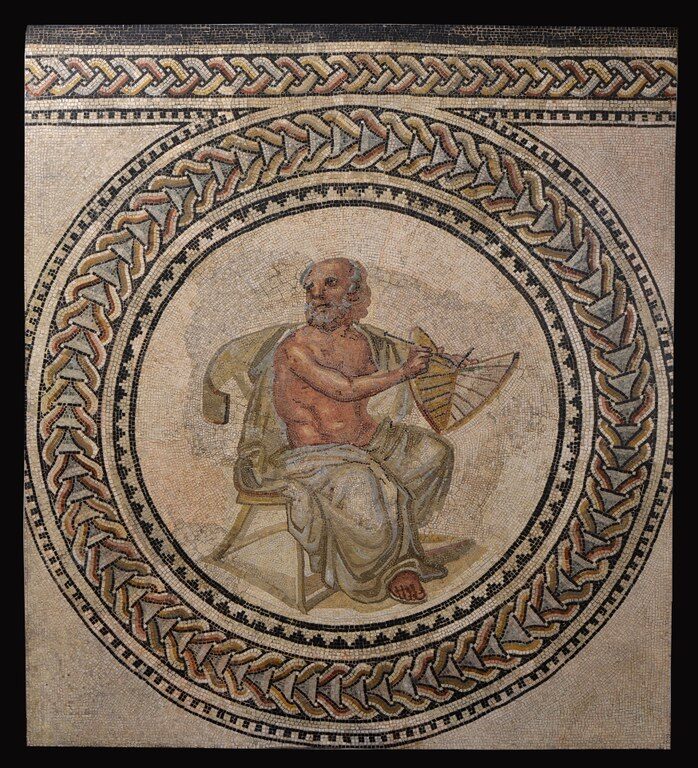
Life
Anaximander in their own century
Anaximander of Miletus wrote the earliest Greek prose work we know of, of which a single sentence survives. He is credited with a map of the inhabited world, an instrument for tracking the sun's shadow, and the claim that the earth hangs unsupported at the centre of things.
The Milesians worked in a city that measured land, navigated by the stars and argued in public. Anaximander's cosmology reads as an attempt to make those practical measures into an account of the whole.
Central ideas
The boundless
He called the origin the apeiron, the boundless: not water, air or fire, because anything definite would in time overwhelm its opposites.
An earth with no support
The earth stays where it is because it is equally distant from everything else, an argument from symmetry rather than from a supporting sea or pillar.
Life from moisture
Living things arose from moisture, and the first humans grew inside fish-like creatures, since a human infant could not have survived on its own.
Criticism & debate
The one fragment is short and its wording disputed, so most of what is said about him rests on summaries written centuries later, above all by Theophrastus.
Influence
The demand that the origin be indefinite, and the argument from symmetry, shaped later cosmology. His fragment is the earliest surviving sentence of Greek philosophy.
How to read them
Begin Anaximander with the tension between the boundless and an earth with no support. Read the major works slowly enough to notice how biography, public crisis and method shape the argument rather than treating the thinker as a list of doctrines.
If Anaximander is right about the boundless, what habit of judgement would have to change first?