Marxism
History and society interpreted through material relations.
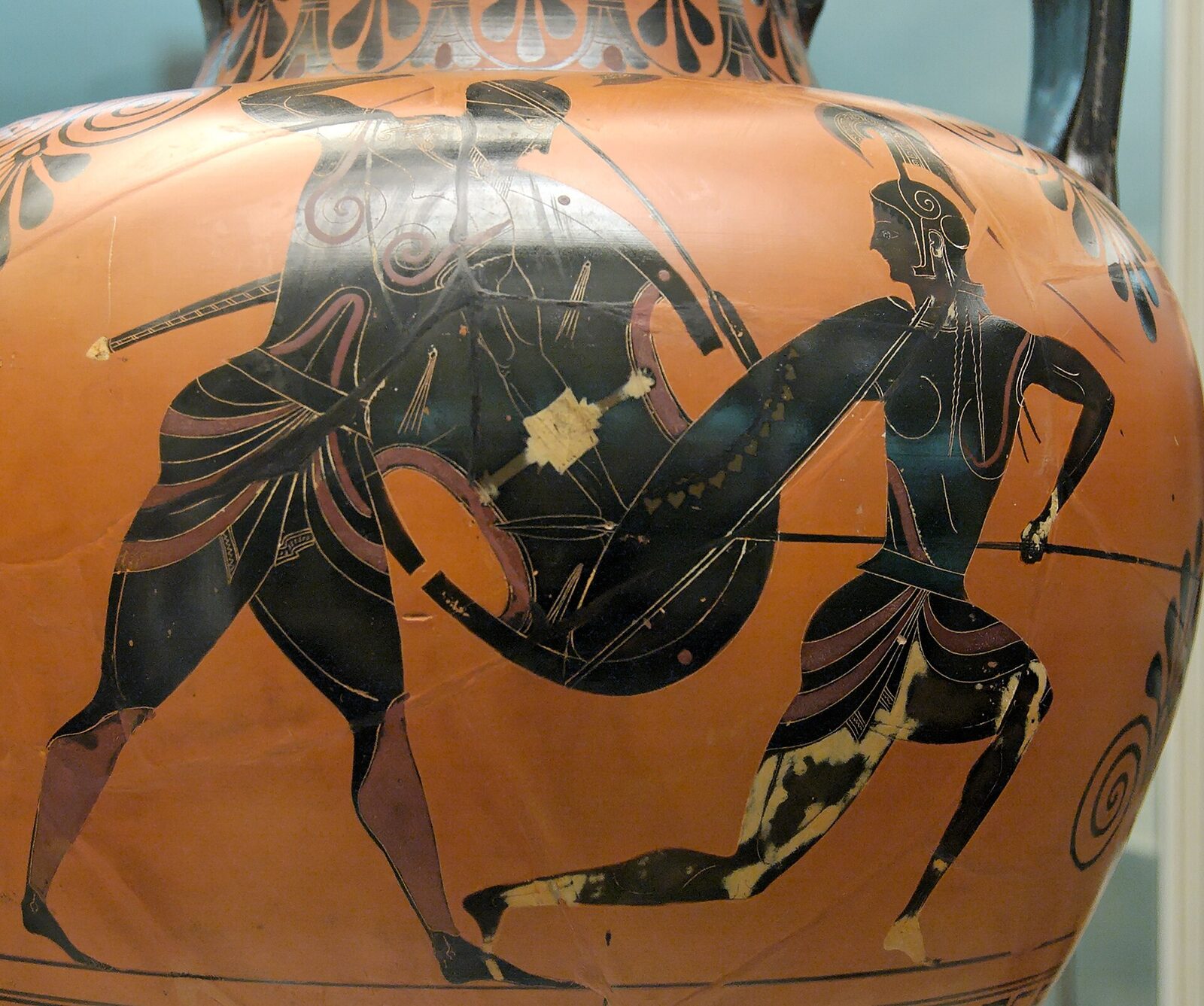
Attic black-figure amphora with Achilles and Penthesileia, c. 540–530 BCE · British Museum
Origin
Developed by Karl Marx and Friedrich Engels from the 1840s.
Central claims
- Social forms are shaped by material and productive relations.
- Labour under capitalism can alienate people from their activity.
- Class conflict drives historical change.
Criticism
Critics dispute its predictions, its treatment of individual freedom, and the record of states claiming its name.
Development
Marxism began as a critique of political economy and became a global tradition of history, sociology, party politics, labour organising and cultural analysis. Its central claim is that ideas must be read alongside the material relations that make them plausible.
Legacy
Even critics of Marxism rely on its questions about labour, ideology, class and commodification; the tradition’s burden is to answer for the violence and authoritarianism committed in its name.
In their words
“The philosophers have only interpreted the world in various ways; the point, however, is to change it.”
“Men make their own history, but they do not make it as they please.”
“The history of all hitherto existing society is the history of class struggles.”